
One name, two materials
We bought polyglyceryl-6 polyricinoleate twice, from two suppliers, under the same INCI name and the same CAS number. The two materials are not the same thing, and you can tell by pouring them.
File 01 opened in August with a question we could not answer: three INCI names in circulation, two CAS numbers, one of them shared with a food additive, and no way to tell from the paperwork which material had actually arrived. It has taken a second supplier, a mass spectrum and a pair of beakers to get anywhere near an answer.
Polyglyceryl polyricinoleate is a water-in-oil emulsifier. It is a polyglycerol backbone — glycerol molecules joined in a chain — with polyricinoleic acid chains hanging off it. The number in the name is how many glycerol units are in the backbone, and it is the number that decides how the material behaves.
What a CAS number cannot tell you
A CAS number identifies a substance. Polyglyceryl esters are not substances in that sense — they are distributions. A “polyglyceryl-6” material is not six glycerol units exactly; it is a spread of chain lengths centred somewhere near six, and the spread is as much a part of the specification as the average.
- 29894-35-7 is generic polyglycerol polyricinoleate — food additive E476, no defined chain length. It should not appear on a sheet claiming PG-6, and it does, often.
- 114355-43-0 is specifically the hexaglycerol ester. This is the unambiguous number.
- 107615-51-0 is also cross-listed against Polyglyceryl-6 Polyricinoleate in the INCI dictionary, which makes it vague rather than wrong.
A CAS number on a specification sheet is a claim about identity. It is not a measurement of chain length, and chain length is the thing that decides whether your emulsion holds.
The tests that do decide it are hydroxyl value, which scales with the number of free hydroxyl groups on the backbone; gel permeation chromatography, which measures the molecular weight distribution; and mass spectrometry, which shows the chain lengths directly.
The mass spectrum
One of our two suppliers sent a MALDI-TOF mass spectrum, unasked. It is the first time in this series that a supplier has sent us analytical data rather than a table of conclusions, and it settles in one page what a CAS number cannot settle at all.
A mass spectrum of a polymer is a series of peaks separated by the mass of whatever repeats. Reading the spacings in the supplied data:
Two repeating units, both matching theory to three decimal places. A polyglycerol backbone carrying polyricinoleate chains, shown directly rather than asserted.
The certificate also carries an acceptance criterion we had not seen before and have since adopted: no ion peaks showing differences of 44, 58, or their multiples. Forty-four is ethylene oxide. Fifty-eight is propylene oxide. The supplier is proving the backbone is polyglycerol and not a cheaper ethoxylated or propoxylated polymer wearing its name. It is a well-designed test and it passed.
Six numbers that agree with each other
What makes this certificate credible is not any single figure. It is that the figures are consistent with one another, and consistency of that kind is very hard to fabricate.
- Saponification value 189 mgKOH/g implies about 12.4 ester groups per molecule.
- Hydroxyl value 55 mgKOH/g implies about 3.6 free hydroxyl groups remaining.
- A hexaglycerol core weighs 462 daltons; twelve ricinoleoyl units add about 280 each; the molecule should therefore weigh roughly 3,825 daltons.
- Their gel permeation chromatography reports a number-average molecular weight of 3,679 — within 4 % of that estimate.
- Iodine value 85 is right for one carbon-carbon double bond per ricinoleoyl unit, which is what ricinoleic acid has.
- Acid value 5.9 mgKOH/g and lead not detected.
Four independent measurements, arrived at by four different methods, describing the same molecule. That is what a certificate of analysis is supposed to look like.
In File 02 we wrote about a certificate that confirms nothing. This is the opposite pole, and it is worth saying so: the document and the material agree.
One limit worth stating. The data strongly supports a polyglycerol polyricinoleate with roughly twelve ricinoleoyl units. Distinguishing a six-unit backbone from a three-unit one rests mainly on the hydroxyl value, and PG-6 fits better than PG-3 does — but we would call that consistent rather than proven.
One batch, three certificates
We were sent three certificates for the same batch number. They are not identical, and the difference is worth recording.
The custom version tightens the acid-value limit from 12.0 to 6.0 while the measured result stays at 5.9 — passing by a tenth of a unit — and drops the hydroxyl value and viscosity rows entirely.
Nothing was falsified. The result is the same on all three. But a specification limit was edited to match what a customer asked for, rather than the material being re-tested against it. It is a useful reminder that on any certificate the limits are negotiable and the results are the information. Read the right column.
The pour test
Polyglyceryl polyricinoleate is a thick, sticky liquid. The characterised supply is reported at 2,950 mPa·s at 25 °C — roughly the consistency of honey. That is not a preference of the manufacturer; it is what a branched polymer of that molecular weight does.
Here are the two materials, poured into the same 50 mL beaker on the same bench.
We have not put a number on Supply A. Our viscometer reading was taken without a recorded torque value, and a reading we cannot defend is worse than no reading, so we are describing what we saw rather than quantifying it. It pours freely, with the body of a thin carrier oil. That measurement is still owed, and when we have it properly it will be added here.
The plausible explanations for a thin polyglyceryl polyricinoleate are dilution with a light carrier oil, a much shorter polyglycerol backbone, or a different ester entirely. We cannot distinguish between them.
The beaker
Then the test that matters to anyone actually making something. Two emulsions, identical in every respect except which polyglyceryl polyricinoleate went into them. Same formula, same process, same day. Left standing 24 hours.
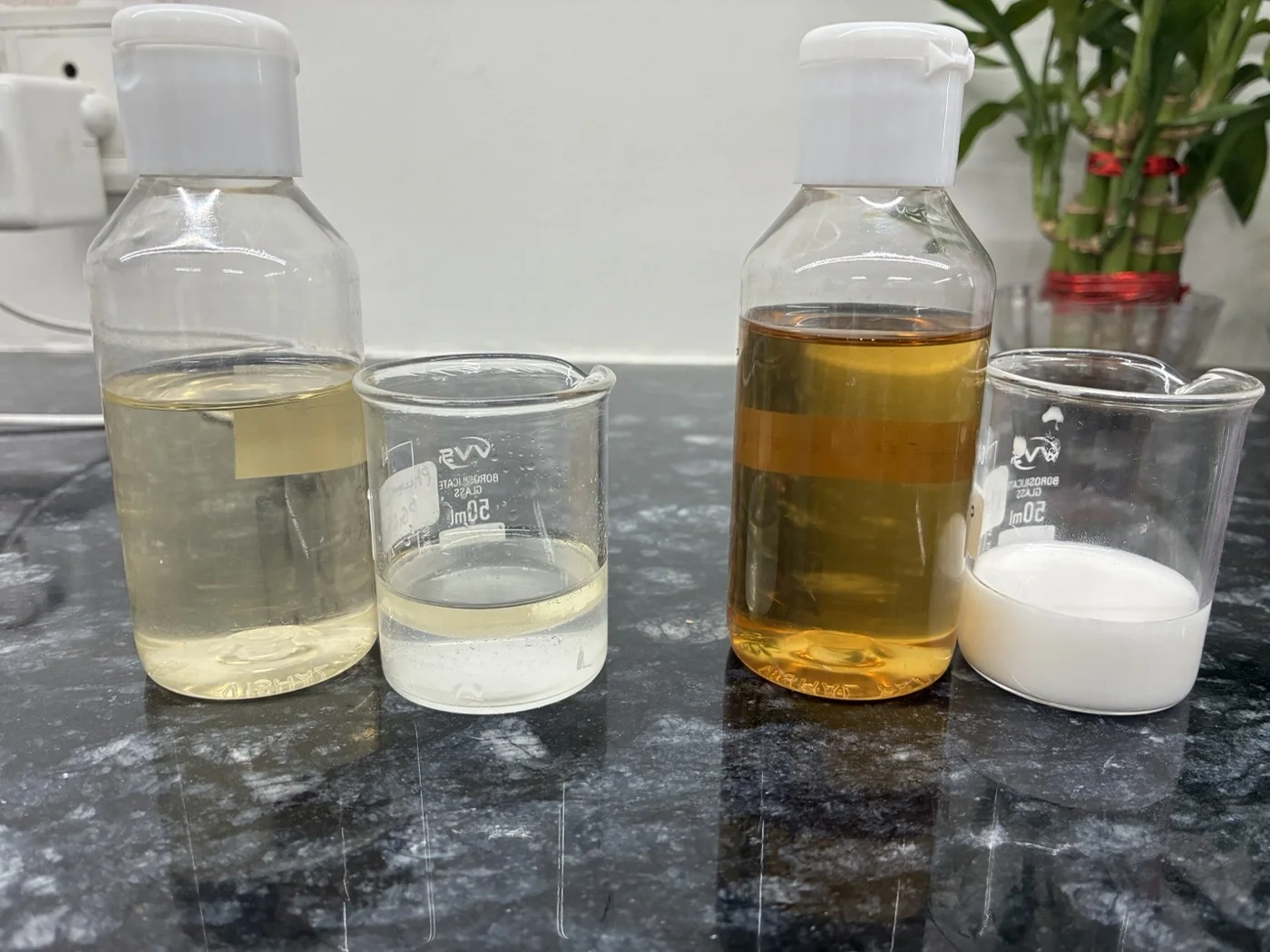
The paperwork predicted the beaker.
That sentence is the entire point of this file, and of the two before it. A mass spectrum, a molecular weight distribution and a viscosity figure are not bureaucracy. They told us, before we weighed anything, which of these two materials would make a cream.
What we still cannot say
- We cannot say what Supply A is. We can say it does not pour like a polyglyceryl polyricinoleate and does not emulsify like one. Identifying it would need the same MALDI-TOF and GPC the other supplier provided, and we have not run them.
- We cannot say Supply A was misrepresented. We have no certificate to compare the material against, which is itself the problem, and no analytical proof of substitution.
- We have not independently verified Supply B. The mass spectrum, the GPC and the six wet-chemistry values are the supplier's own, not ours. They are internally consistent and they predicted the emulsion result, which is strong circumstantial support — but we did not measure them.
- The viscosity of Supply A is not quantified. Stated above, stated again here, because it is the one number this file is missing.
- We do not name Supply A. When we have identification data, we will publish the data.
We do name Supply B, because there is nothing adverse to say: Unilong Industry Co. Ltd of Jinan, Shandong sent a certificate of analysis, a safety data sheet, a mass spectrum and a molecular weight distribution, without being asked twice. Credit where it is earned.
What this changes
Three things have gone into our own practice as a result of this file.
- We ask every supplier of a polymeric material for hydroxyl value and a molecular weight distribution, not a CAS number. The CAS number is now recorded as a claim, not as evidence.
- We have adopted the ethylene oxide and propylene oxide check as a standing question for any polyglyceryl material: can you show there are no mass differences of 44 or 58? It is a precise question and the answer is informative either way.
- Every vendor record now carries one more field: manufacturer, or distributor? A trader cannot give you a certificate for a batch they did not make, and most of the search results for a cosmetic raw material in India are traders.
The broader point is the one running through this whole series, and it is the subject of our first paper: a number on a document is not a measurement, and the gap between the two is where everything goes wrong.
Revisions
- 2026-10-02File opened. A second supply of the same INCI material arrived fully characterised by MALDI-TOF, GPC and wet chemistry. Compared against the original material by pour behaviour and by performance in an otherwise identical emulsion. File 01 asked which material had arrived; this one answers it for one of the two.
This file stays open. Results are added here as they arrive, and corrections are logged rather than quietly edited away.
Corrections and contributions
If you manufacture polyglyceryl esters and can tell us what a PG-3 versus a PG-6 hydroxyl value should look like in practice, we would like to hear from you. If you have bought this material and measured it, we would like that too. If anything in this file is wrong, tell us and we will correct it in place, with the correction noted and dated.
care@raupyam.com · +91 74001 44899
Raupyam Labs Limited. This file describes raw-material characterisation and makes no claims regarding any finished product. Analytical data attributed to Unilong Industry Co. Ltd is theirs and was supplied with the material; we have not independently repeated it. Polyglyceryl-6 Polyricinoleate is an established cosmetic ingredient and nothing here is a criticism of the ingredient, only a record of what was supplied to us under that name. Trademarks referenced belong to their respective owners.