
The offer that should not exist
Isobutylamido thiazolyl resorcinol is not an ordinary raw material you shop around for. It is patented, and it is sold almost exclusively inside the products of the company that patented it.
The molecule is marketed as Thiamidol. It belongs to Beiersdorf — the parent of Eucerin and Nivea — which holds patents on it and uses it in those brands. Independent commentary is consistent on this point: you will reliably find the genuine material only inside Beiersdorf's own lines, and an unaffiliated brand claiming to supply it warrants skepticism.
So when a supplier we had never dealt with offered us the material by the kilogram — a firm quote of USD 672 per kilo, powder ready to ship — the offer itself was the first anomaly. If the molecule is protected and brand-exclusive, what is being offered?
A patented, brand-exclusive active does not have an open wholesale market. An open wholesale offer for it is therefore a question, not a purchase.
What the molecule is
Isobutylamido thiazolyl resorcinol, CAS 1428450-95-6, is a resorcinol derivative that inhibits tyrosinase — the enzyme that governs melanin production — and so acts as a skin-brightening agent. Its molecular formula is C13H14N2O3S, molecular weight about 278.
What makes it valuable is a specific piece of chemistry: it is a potent inhibitor of the human enzyme, not merely of the mushroom tyrosinase that most brightening actives are screened against as a lab convenience. That distinction — real-target potency — is what its owner spent years and a large screening programme to find, and it is why the molecule is guarded.
None of that chemistry is in dispute. The dispute is narrower and sharper: when a plain sachet of white powder arrives, how do you know it is this molecule and not something cheaper wearing its name?
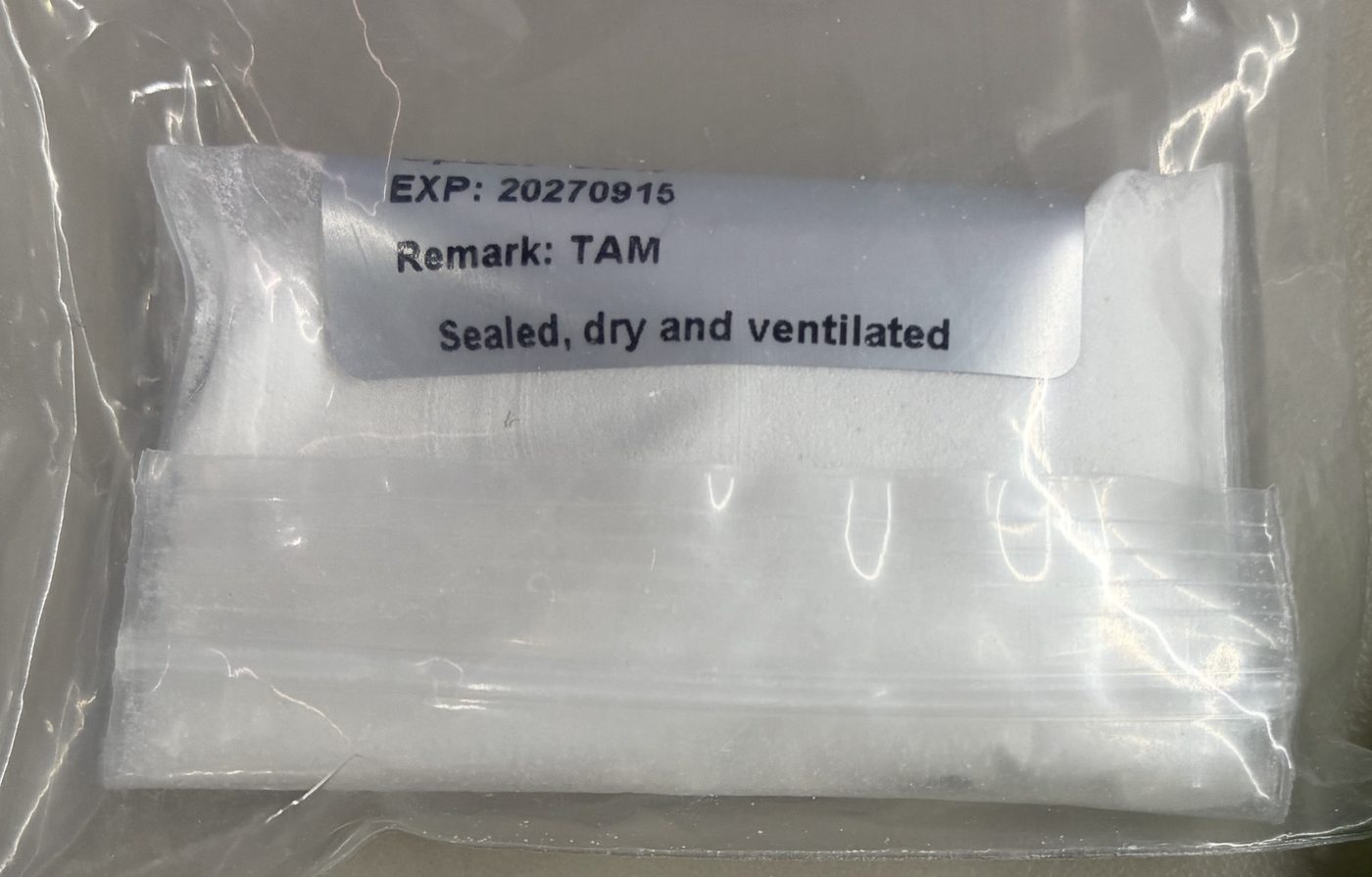
The certificate that confirms nothing
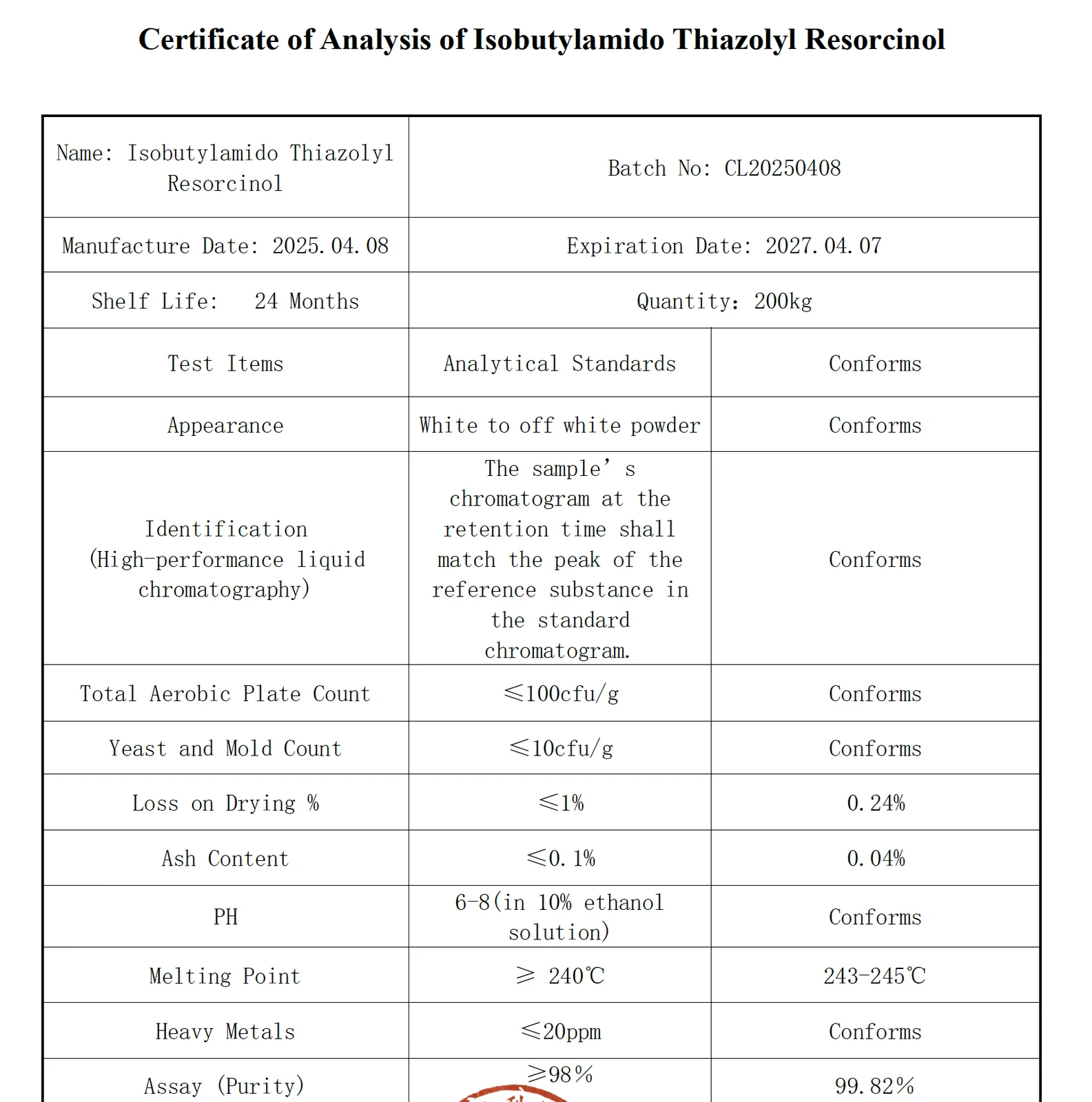
A certificate of analysis arrived. It is neatly laid out, it reports a long list of tests, and every line reads "conforms." Read closely, it confirms far less than it appears to.
- Identity by circular reference. The identification test states that the sample's chromatogram, at the retention time, matches the peak of the reference substance in the supplier's own standard. That proves the sample matches whatever the supplier has chosen to call the reference. It does not prove the reference is the patented molecule. If the reference itself were a cheaper analogue, the sample could match it perfectly and the certificate would still read “conforms.”
- Purity is not identity. The assay is reported at 99.82%. That says the powder is one clean compound. It does not say which compound. A 99.82%-pure analogue satisfies this line completely.
- No CAS on the certificate. We had asked, explicitly, for CAS 1428450-95-6. The certificate names the material but does not carry the number, and nothing on it ties the powder to that registry entry.
- No structural confirmation. There is no NMR. Melting point and appearance are consistent with the claimed material, but they are consistent with a range of related solids too.
"Matches our reference" is not identity. It is a mirror. It tells you the sample equals the supplier's chosen standard — and says nothing about what that standard is.
The three questions
We replied with the three requests that would settle identity. They are not exotic; any manufacturer of the genuine molecule can answer them.
- NMR. An ¹H-NMR spectrum (in DMSO-d₆, 400 MHz or above) with integrals, and the raw data if available. Mass spectrometry confirms a molecular weight but cannot, on its own, distinguish every structural arrangement; NMR is what confirms the specific isobutyl substitution that defines this molecule.
- The reference standard's source. Their identification rests on a reference substance. We asked them to supply that reference's chromatogram, run on the same method, and to state where the reference came from — because an identity claim is only as good as the standard behind it.
- The full method. Column, mobile phase, gradient, flow rate, column temperature, sample preparation — so we could verify incoming lots against their release method ourselves. And, plainly: are you the manufacturer, or a distributor?
We received no reply.
The questions that a genuine manufacturer answers in an afternoon are the same questions that end a conversation when the answer is inconvenient. Silence is data.
The trap: you may not be able to verify it at all
Here is the part that makes this material different from an ordinary verification. Suppose we spent the money on independent analysis. To confirm identity beyond doubt, we would compare the sample against an authentic reference standard of the real molecule. But the authentic material is controlled by the company that patents it. There is no open, trustworthy commercial source of a reference standard for a molecule whose whole commercial point is exclusivity.
So the ordinary escape — "just test it against the real thing" — is partly closed. You can characterise the powder in the abstract; confirming it is the patented molecule, and not a close relative, is much harder when you cannot legitimately hold the genuine article to compare.
And this is not our private bad luck. It is a live, documented conflict. In early 2026, the patent holder publicly raised concerns that a newly announced Chinese whitening compound might infringe its patent on this molecule, after a domestic developer promoted it as a home-grown equivalent. When the world's owner of a molecule is actively disputing who else may make something like it, a quiet wholesale offer of the molecule itself deserves the scrutiny we gave it.
What we cannot conclude
We want to be exact about the limits of what we know, because the temptation here is to say more than the evidence allows.
- We cannot say the supplier sent a counterfeit. We have no analytical proof of what the powder is. We have a certificate that does not confirm identity and questions that went unanswered — which is suspicion, not a finding.
- We cannot say what the powder is. It may be the genuine material; it may be a related tyrosinase inhibitor; it may be something else. Without NMR against a trustworthy reference, we do not know.
- We do not name the supplier. Naming a party while claiming, without proof, that they misrepresented a product is both unfair and legally reckless. When we have analytical data, we will publish the data.
The honest description of our position is not "they cheated us." It is "we could not verify it, and neither, on this evidence, could they."
The decision
We stopped trying to source the patented molecule. Not on principle, and not out of suspicion of any one supplier — on verifiability. If you cannot obtain a trustworthy reference standard for a material, you cannot confirm its identity, and a material you cannot confirm has no place in a formulation we would stand behind.
The constructive path is a brightening active in the same family that is legally available and independently verifiable — one where an authentic reference standard can be bought, NMR run, and incoming lots checked against a real specification. A molecule we can prove, at a modest cost, beats a more famous one we can only hope about. That choice — provable over prestigious — is the whole reason this file exists.
Subsequent files continue the same work, one material at a time.
Revisions
- 2026-08-31File opened. Supplier exchange and certificate recorded; identity unconfirmed. Nothing verified yet.
This file stays open. Results are added here as they arrive, and corrections are logged rather than quietly edited away.
Corrections and contributions
If you manufacture this molecule and can supply NMR against a stated reference, or can point to a legitimate source of an authentic reference standard, we would like to hear from you. If anything in this file is wrong, tell us and we will correct it in place, with the correction noted and dated.
care@raupyam.com · +91 74001 44899
Raupyam Labs Limited. This file describes raw-material characterisation and makes no claims regarding any finished product or any named supplier. Trademarks referenced belong to their respective owners.