
The bottle that opened this file
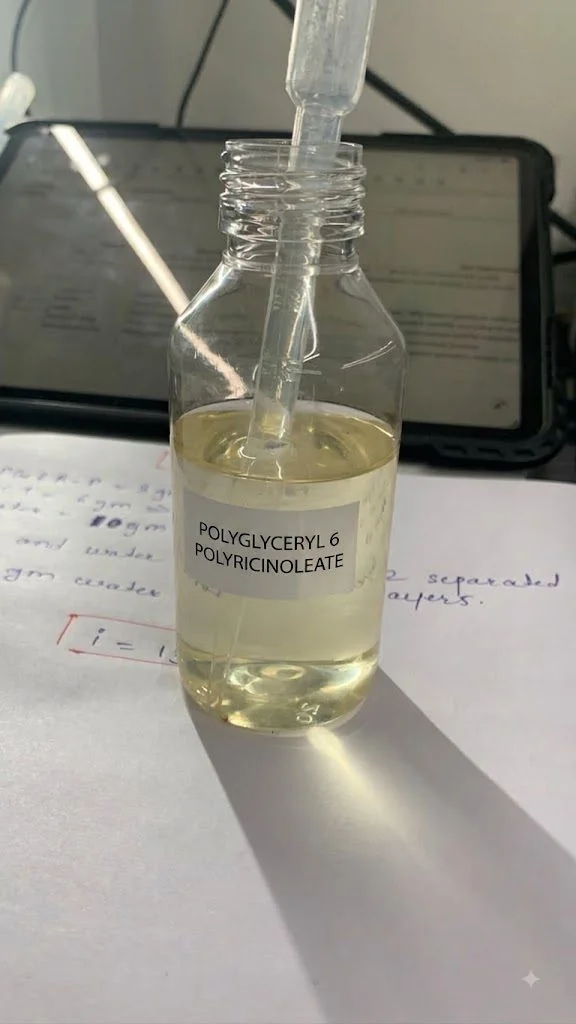
A pale yellow liquid, thinner than it should be, in a bottle labelled with an INCI name we had ordered against a CAS number we had specified.
Polyglyceryl-6 polyricinoleate is a heavy material. Castor oil is already a thick oil; a polyglycerol ester of polymerised ricinoleic acid should be thicker still. What we poured moved like a light oil.
That is a flag, not a finding. Colour and viscosity judged by eye are worth nothing as evidence, and this file exists precisely because we are not willing to treat them as such. But it was enough to make us ask whether the paperwork in the box described the liquid in the bottle — and to discover that we had no way to check.
What we were trying to make
A water-in-oil emulsion. In an oil-in-water cream — most lotions you have used — tiny droplets of oil float in a continuous phase of water. A water-in-oil emulsion is the reverse: droplets of water suspended inside a continuous oil phase. It feels richer, resists water better, and is much harder to stabilise.
Holding it together needs an emulsifier that prefers oil to water. Chemists describe that preference with a number called HLB, for hydrophilic-lipophilic balance. Low HLB means oil-loving. Water-in-oil emulsifiers sit at the low end, usually around 3 to 4.
Polyglyceryl-6 polyricinoleate is specified for exactly this job, and particularly for emulsions with a high internal water phase — meaning it should hold a lot of water inside the oil.
Ours would not hold 5 g of water in a 100 g batch. That is not a marginal failure. That is a material behaving nothing like its specification.
What the molecule is supposed to be
Two pieces, esterified together. The backbone is polyglycerol — glycerol molecules linked into a short chain. The number in the INCI name is the chain length: polyglyceryl-3 means roughly three glycerol units, polyglyceryl-6 roughly six. This is the water-liking end.
The tail is polyricinoleate: ricinoleic acid from castor oil, but polymerised. Ricinoleic acid is unusual among fatty acids in carrying a hydroxyl group partway along its chain. That hydroxyl lets one molecule esterify to the next, forming chains called estolides. This is the oil-liking end, and it is bulky.
One consequence matters later in this file: the polymerisation consumes hydroxyl groups. Castor oil is full of free hydroxyls. A properly made polyricinoleate has spent many of them building estolides — and that difference is cheap to measure.
Three names, two CAS numbers
Scroll table horizontally →
| Polyglyceryl-3 PR | Polyglyceryl-6 PR | PGPR (food) | |
|---|---|---|---|
| CAS | 29894-35-7 | 107615-51-0 | 29894-35-7 |
| COSING | 78902 | 58637 | E476 |
| HLB | ~3–4 | low | low |
| Typical use | Soft W/O, balms | W/O, high water | Chocolate, spreads |
| Appearance | Yellowish viscous | Amber viscous | Amber viscous |
Read the CAS row again.
Polyglyceryl-3 polyricinoleate and food-grade PGPR share a CAS number. They are, for registry purposes, the same substance — and the cosmetic INCI entry for polyglyceryl-3 polyricinoleate is itself commonly abbreviated PGPR.
So a supplier offering PGPR with a certificate referencing the food additive E476 is not necessarily doing anything dishonest. They may be selling precisely what they say, under the name the food industry uses for it.
Polyglyceryl-6 polyricinoleate is a different registry entry: 107615-51-0. Longer backbone, different water-holding behaviour, different CAS.
If you ordered polyglyceryl-6 polyricinoleate and the certificate cites CAS 29894-35-7, you were not sent polyglyceryl-6.
That is a documentable mismatch on paper. It needs no laboratory to detect, and no accusation to state.
Is polyglyceryl-3 polyricinoleate the same as food-grade PGPR?
By CAS registry, yes. What differs is the specification each grade is held to: permitted impurity limits, residual solvents, heavy metals, and the documentation regime behind them. Food-grade E476 has published specifications and a defined acceptable daily intake. Cosmetic grade carries no equivalent universal monograph.
The honest position is narrower than food grade is fake. It is this: the name tells you the chemistry, not the purity, and not the chain length.
What the certificates looked like
Across the samples we requested, a pattern.
- No batch number. The certificate describes a material in the abstract, not the container in front of us. A certificate of analysis without a lot number is not a certificate of analysis; it is a brochure.
- Identical digital formatting across unrelated vendors, suggesting a common origin document rather than independent testing.
- Grade language that drifts between the cosmetic INCI and the food additive within the same document.
We are not naming vendors. Not out of diplomacy, but because we have no analytical data, and an accusation without data is worth nothing — including to us. When we have numbers, we will publish the numbers.
What we cannot conclude yet
Our emulsion failed. That is a fact. It does not establish that the material was misrepresented. Standing between the observation and that conclusion:
- Our own protocol. Water addition rate, shear and phase temperature sink water-in-oil emulsions routinely, with entirely genuine emulsifier.
- Emulsifier system, not emulsifier. Commercial formulations built on polyglyceryl-6 polyricinoleate typically pair it with a co-emulsifier and a rheology modifier such as disteardimonium hectorite. Ours ran without.
- Electrolyte level. 0.7 g in a 100 g batch is normal. Whether it was optimal for this system is untested.
- Appearance proves nothing. Genuine polyricinoleate esters are also yellow to amber viscous liquids.
- Wrong material is not the same as dishonest supplier. Being sent polyglyceryl-3 when you asked for polyglyceryl-6 may be substitution, mislabelling, or a vendor who does not distinguish them.
Until these are excluded, the correct description of our position is that we do not know.
How we intend to find out
Stating the method before we have results, so the result cannot be accused of being fitted to the grievance.
Stage 1 · bench checks, no instrument
Ethanol solubility. Castor oil dissolves readily in ethanol, unusually so among vegetable oils, because of those free hydroxyls. Polyglycerol polyricinoleate is documented as insoluble in ethanol. If our sample goes clear and homogeneous in absolute ethanol, we have a serious problem to explain.
Side-by-side comparison. Equal volumes of our sample and known castor oil at the same temperature: pour rate, thread on withdrawal of a rod, ethanol behaviour. Two knowns compared beat either alone.
Hydroxyl, saponification and acid value. Classical titrations. Castor oil sits around 160–168 mg KOH/g hydroxyl value. A polyricinoleate, having consumed hydroxyls to form estolides, should differ materially. We will take reference figures from the published E476 monograph rather than secondary sources, and state which edition we used.
Stage 2 · chain length, if Stage 1 does not settle it
The question Stage 1 cannot answer is how long the polyglycerol backbone is — the difference between a 3 and a 6.
Route A. Alkaline hydrolysis of the ester, isolation of the polyglycerol fraction, determination of oligomer distribution (di-, tri-, tetra-, penta-, hexaglycerol) by HPLC-ELSD, or by GC after silylation. Reported as relative distribution.
Route B. Aqueous gel permeation chromatography of the isolated polyglycerol fraction, with refractive index detection.
We would prefer Route B where available. The question is purely one of oligomer size distribution, and size exclusion answers it directly without a derivatisation step. One practical constraint worth stating publicly: polyglycerols carry no chromophore, so a UV detector will not see them. Any laboratory quoting this work needs ELSD, CAD or RI detection — or the derivatisation route.
What would prove us wrong
If the polyglycerol distribution centres on six units, the hydroxyl value falls within the polyricinoleate range, and the material is ethanol-insoluble, then we received what we ordered and our emulsion failed for reasons of our own making. We will publish that outcome with the same prominence as any other.
Why publish an unfinished investigation
Because the finished version would be less useful. Most raw material problems in this industry are resolved privately, or not at all, and the knowledge dies inside one lab. A file left open — with the method fixed in advance and the disproof condition stated — is something another formulator can check, argue with, or run themselves.
Subsequent files follow the same structure, one material at a time.
Revisions
- 2026-10-02A second supply of polyglyceryl-6 polyricinoleate arrived from a different manufacturer, characterised by MALDI-TOF, GPC and wet chemistry. Comparing the two answers part of the question this file opens with. Recorded separately as File 04 rather than rewritten in here.
- 2026-08-16File opened. Bench observations recorded, method pre-registered. Nothing verified yet.
This file stays open. Results are added here as they arrive, and corrections are logged rather than quietly edited away.
Corrections and contributions
If you have run identity work on polyglyceryl polyricinoleates, hold reference material, or can point to a laboratory equipped for the analysis described above, we would like to hear from you. If anything in this file is wrong, tell us and we will correct it in place, with the correction noted and dated.
care@raupyam.com · +91 74001 44899
Raupyam Labs Limited. This file describes raw material characterisation and makes no claims regarding any finished product.