
Two powders that should have been liquids
Biosaccharide Gum-1 and Biosaccharide Gum-4 are fermentation-derived polysaccharides used for their soothing and film-forming properties. Both are normally sold as aqueous solutions at roughly 1 % active. The best-known version of Gum-1 is a liquid.
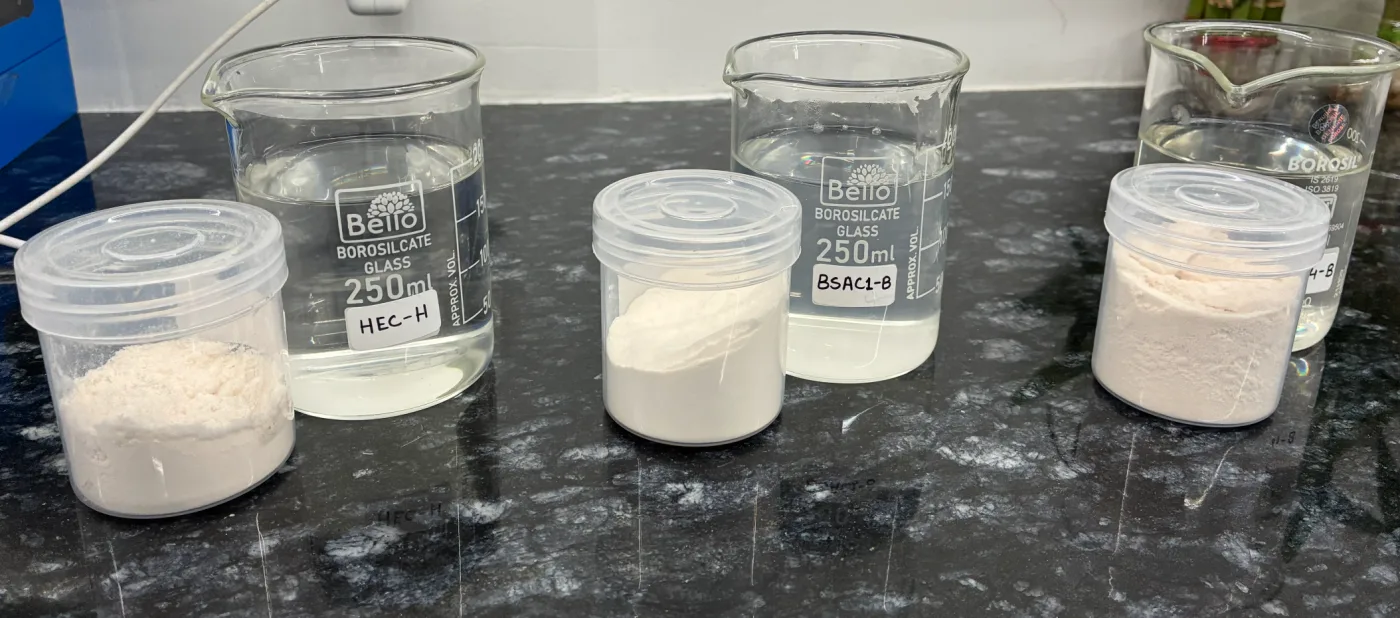
Ours arrived as white powders. Not one of them — both. And they look the same as each other, which is itself odd, because Gum-1 and Gum-4 are different molecules with different sugar compositions.
A powder is not impossible. Spray-dried polysaccharides exist, and they are normally carried on something — maltodextrin, usually. But that changes three things: how much of the powder is actually the gum, how you dose it, and what goes on the ingredient list. None of that was stated.
The certificate that was never going to come
We asked for a certificate of analysis. The answer was that they do not provide one.
That is worth sitting with. A certificate of analysis is not a favour. It is the document that records what a batch was tested for and what the results were, and it is the minimum paperwork for a material going into something that will be left on skin. In File 02 we wrote about a certificate that confirmed nothing. This is the other failure mode: no certificate at all.
A certificate that proves nothing is a documentation problem. No certificate is a decision.
There is a structural reason this happens. Search for a cosmetic raw material in India and what mostly comes back is traders, not manufacturers. A trader will quote you anything, because actually sourcing it is somebody else’s problem — and a trader cannot hand you a certificate for a batch they never made. The question that separates them is the plainest one on our list: are you the manufacturer, or a distributor? We now ask it before we buy, and we record the answer against every vendor.
We are not naming the supplier, for the same reason we did not name one in File 02: we have no analytical proof of what the material is, and an accusation without data is both unfair and reckless. What follows is what we measured.
How they behaved in water
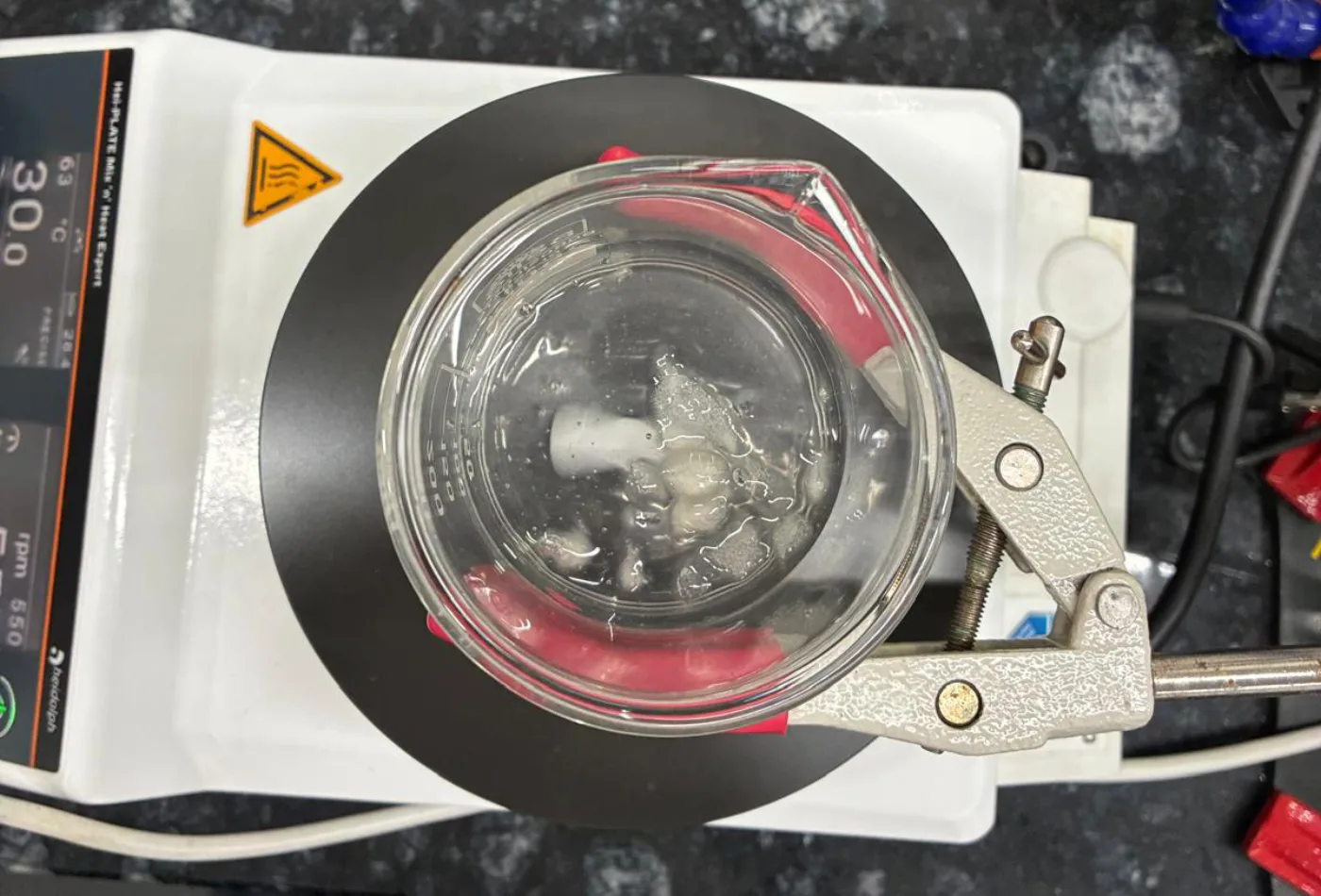
Both solutions were made at 1 % w/w — 2 g of powder into 198 g of water — alongside a hydroxyethylcellulose control at exactly the same concentration, prepared the same way on the same day.
The Gum-1 swelled, lumped into fish-eyes, and then slowly cleared to a thick, very transparent solution. Anyone who has dispersed a cellulose ether will recognise that sequence — it is why several grades are surface-treated to stop them clumping. It is not how a 1 % film-former behaves.
The number that stopped us
Rotational viscometer, same spindle, same session, all solutions at 1 % w/w.
The Gum-1 reads 1406 mPa·sagainst the cellulose control’s 1574. That is 89 % of a high-viscosity thickener, at the same concentration, measured minutes apart.
Biosaccharide Gum-1 is a film-former and a humectant. A 1 % solution should be barely thicker than water. It should not be competing with hydroxyethylcellulose.
The Gum-4 is a different story — 222 mPa·s, and clearly shear-thinning across three speeds, which means something polymeric is present. Still far too viscous for what it claims to be, but not the same material as the Gum-1.
Two products sold under different names, which look identical in the jar, and behave completely differently in water. Only one of those three facts can be right.
One drop of iodine
Iodine turns blue-black with starch and red-brown with dextrins. Cellulose ethers and true polysaccharide gums give nothing. One drop of pharmacy tincture into each 1 % solution:
- HEC control — no reaction. The tube stays the colour of the iodine itself.
- Gum-1 — no reaction. Identical to the control.
- Gum-4 — strong red-brown within seconds. A dextrin is present, almost certainly a maltodextrin carrier.
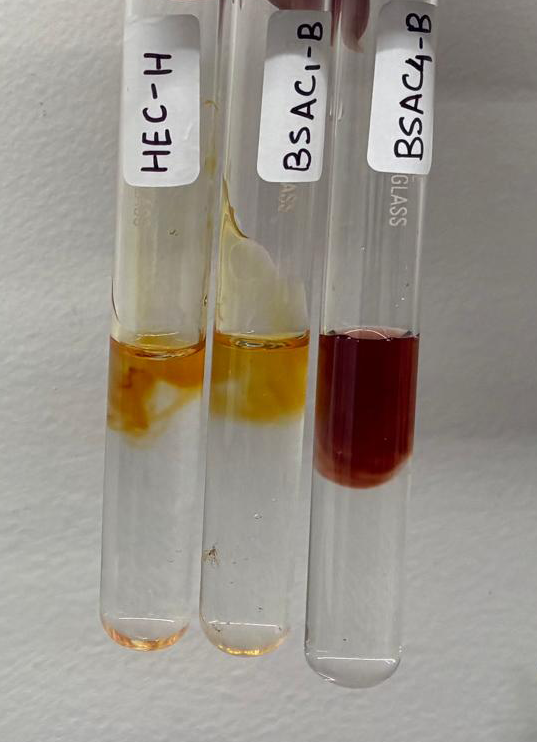
A carrier in a spray-dried product is normal and expected. What is not normal is finding one without being told, and then finding the other powder has no carrier at all while behaving like a cellulose ether.
What we cannot conclude
We want to be exact about the limits here, because the temptation is to say more than the evidence allows.
- We cannot say what either material is. Viscosity and iodine describe behaviour and detect a carrier. Neither identifies a polymer. Establishing identity requires hydrolysing the material and measuring its sugar composition — fucose, galactose and galacturonic acid in roughly equal parts would confirm a genuine biosaccharide gum. We have not done that yet.
- We cannot say the Gum-1 is hydroxyethylcellulose. We can say it is indistinguishable from our hydroxyethylcellulose on every test we have run. Those are different statements and the difference matters.
- We cannot say the supplier misrepresented anything. We have no certificate to compare against, which is precisely the problem, and silence on documentation is not proof of substitution.
- We have not measured loss on drying. Both materials are hygroscopic powders and every figure above is calculated on as-received weight, not dry weight. That is a gap in this file.
- We do not name the supplier. When we have identification data, we will publish the data.
The honest position is not “we were sold the wrong thing.” It is “nothing about this material behaves the way the label says, and there is no document to check it against.”
What happens next
We have ordered genuine Biosaccharide Gum-1 from a manufacturer who will state what it is and supply a certificate. When it arrives we will run every test above again — same concentrations, same instrument, same day, all four samples photographed together.
A reference material does what no amount of argument can. If the genuine product at 1 % is water-thin and ours reads 1406 mPa·s, the comparison speaks for itself. If it does not, we will say so, and this file will record that we were wrong.
We are also building the identity method: acid hydrolysis followed by derivatisation, run on our own chromatography system, looking for fucose. Fucose is a rare sugar. Its presence in the right proportion is close to proof. Its absence is conclusive. That method will then work on every polysaccharide we ever buy, which is the real reason to build it.
Both results will be added to this file, dated, whichever way they go.
Revisions
- 2026-10-01File opened. Physical form, hydration behaviour, viscosity against a cellulose control and iodine screening recorded. Identity not established. Reference material ordered for a side-by-side comparison.
This file stays open. Results are added here as they arrive, and corrections are logged rather than quietly edited away.
Corrections and contributions
If you manufacture Biosaccharide Gum and can tell us what a spray-dried version should measure at 1 %, we would like to hear from you. If you have bought these materials as powders and tested them, we would like to hear that too. If anything in this file is wrong, tell us and we will correct it in place, with the correction noted and dated.
care@raupyam.com · +91 74001 44899
Raupyam Labs Limited. This file describes raw-material characterisation and makes no claims regarding any finished product or any named supplier. Biosaccharide Gum-1 and Biosaccharide Gum-4 are INCI names for established cosmetic ingredients; nothing here is a criticism of those ingredients, only a record of what was supplied to us under those names. Trademarks referenced belong to their respective owners.