
What makes turmeric yellow
In India turmeric needs no introduction. It is in our kitchens, our weddings and our medicine cupboards. We grow up around that colour. But what actually makes it yellow?
Some months ago we decided to find out ourselves, starting not with a commercial extract but with the root. Not because we were developing a turmeric product — we wanted to understand the ingredient, on our own bench, with our own instruments.
The short answer is that nothing makes turmeric yellow, in the singular. The colour is a family of related compounds called curcuminoids, and the three principal ones are curcumin, demethoxycurcumin and bisdemethoxycurcumin. They differ only in how many methoxy groups sit on the rings. To the eye they are one colour. To an analytical chemist they are three different molecules, and every one of them has to be separated from the others before any single one can be measured.
“Curcumin content” on a label is a statement about one member of a family. Whether the number refers to that one compound or to all three together is the first question worth asking.
The rhizome, and what is in it
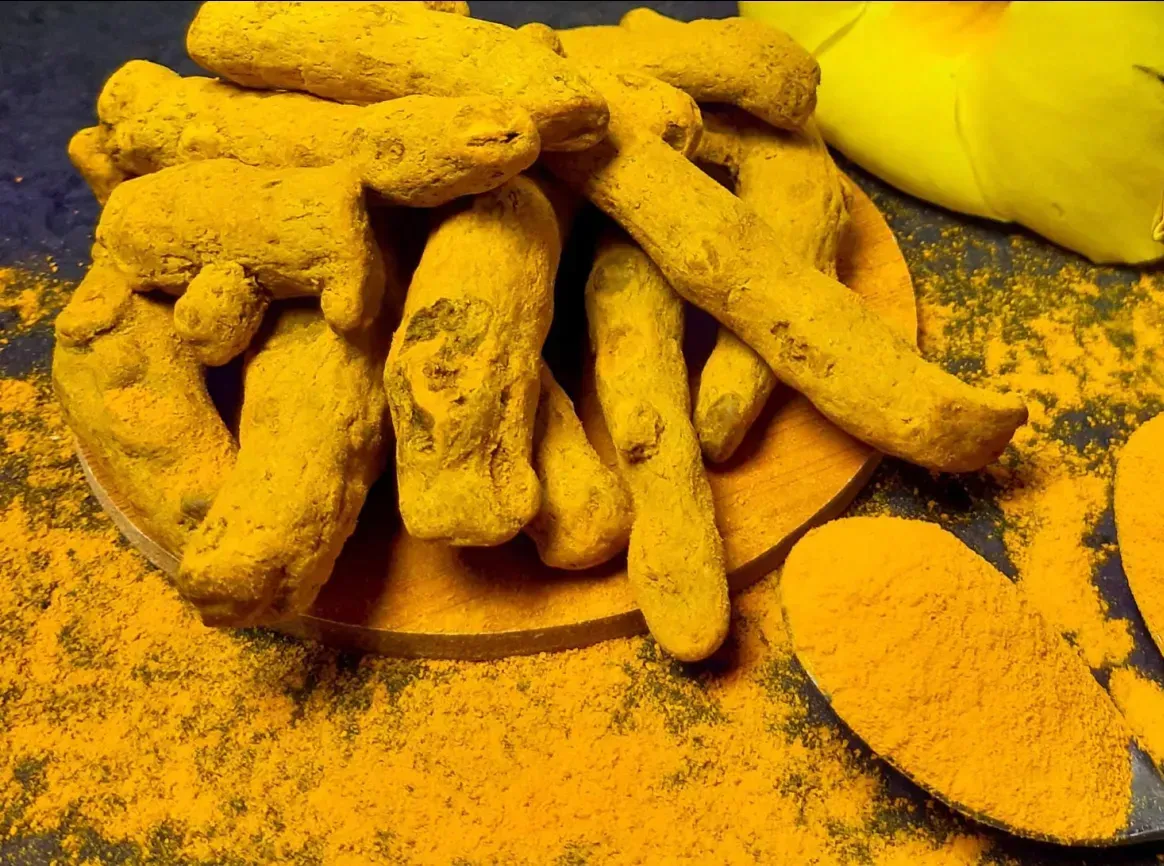
Dried turmeric rhizomes are hard, knuckled things, closer to wood than to spice. Ground down they give the powder everyone recognises.
Curcuminoids are a few per cent of that powder by weight, and the figure varies with variety, soil and season — which is why the same spice from two places can differ considerably once you measure it. The rest is starch, fibre, volatile oils and water, and all of it comes along into any extract unless you take steps to leave it behind.
Extracting a turmeric oleoresin
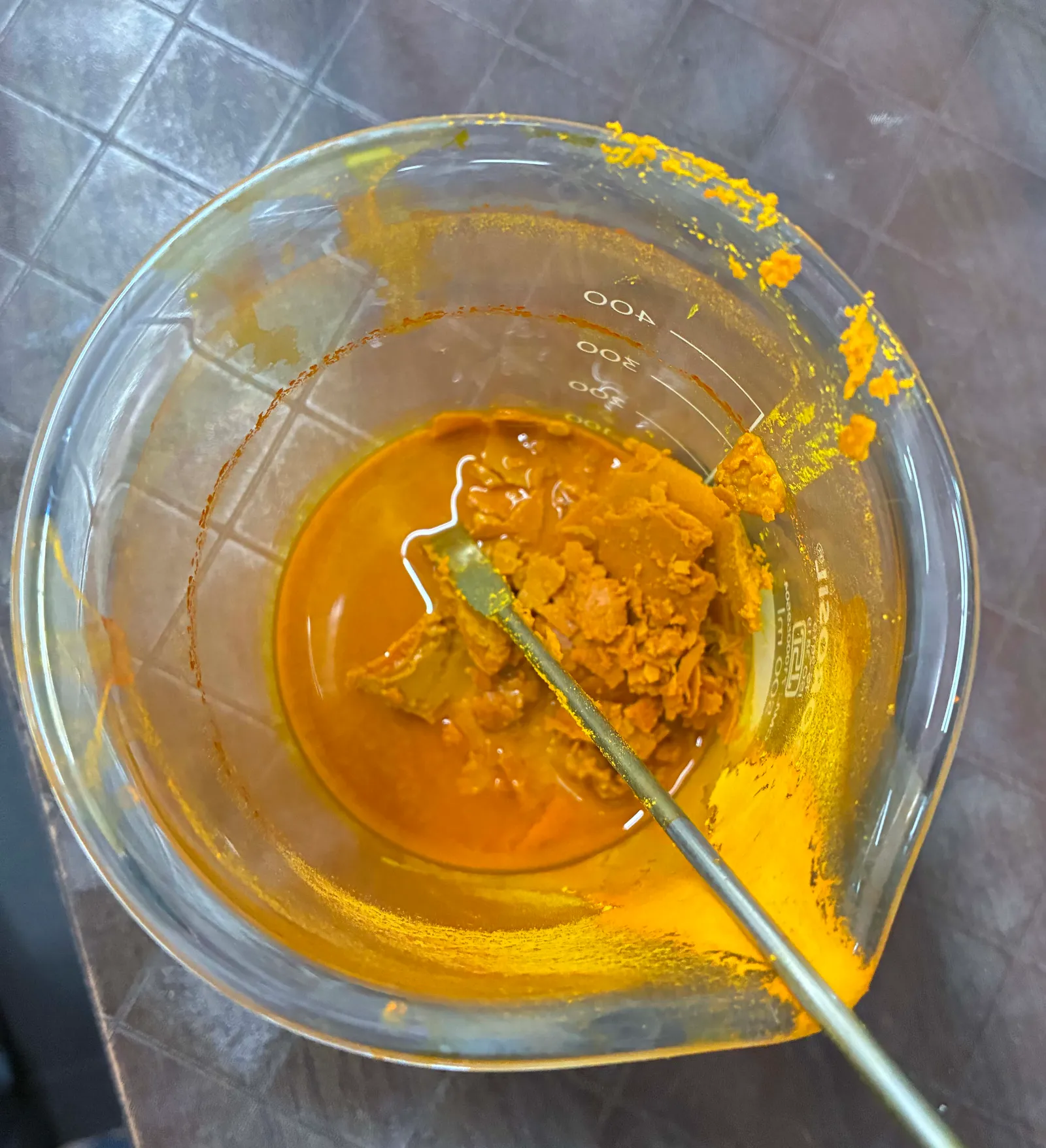
Extraction is less mysterious than it sounds. The compounds sit inside the plant’s cells; you add a solvent that will dissolve them, and you give it time.
It is also an exercise in selectivity. Solvent, temperature and duration between them decide what comes out and what stays behind. Curcuminoids are not very soluble in water and dissolve well in ethanol, which is why an ethanol and water mixture works — the ethanol does the lifting, the water keeps the mixture from pulling out more of the oily fraction than you want.
We were not extracting colour. We were extracting a complex natural mixture, most of which we could not yet name, of which the colour happened to be the visible part.
Rotary evaporation, and why gently
Then the solvent has to go. A rotary evaporator spins the flask in a warm bath under reduced pressure. Lowering the pressure lowers the boiling point, so the solvent lifts off at a far gentler temperature than it would on a hotplate, and the rotation spreads the liquid into a thin film so it leaves faster still.
That matters here, because curcuminoids are thermally sensitive. Heat them hard enough for long enough and you begin converting the thing you are trying to concentrate into something else. The less heat and the less time, the more of the molecule survives the process that was supposed to concentrate it.
Sometimes making an ingredient is mostly about what you take away, and how gently.
From yellow powder to amber oleoresin
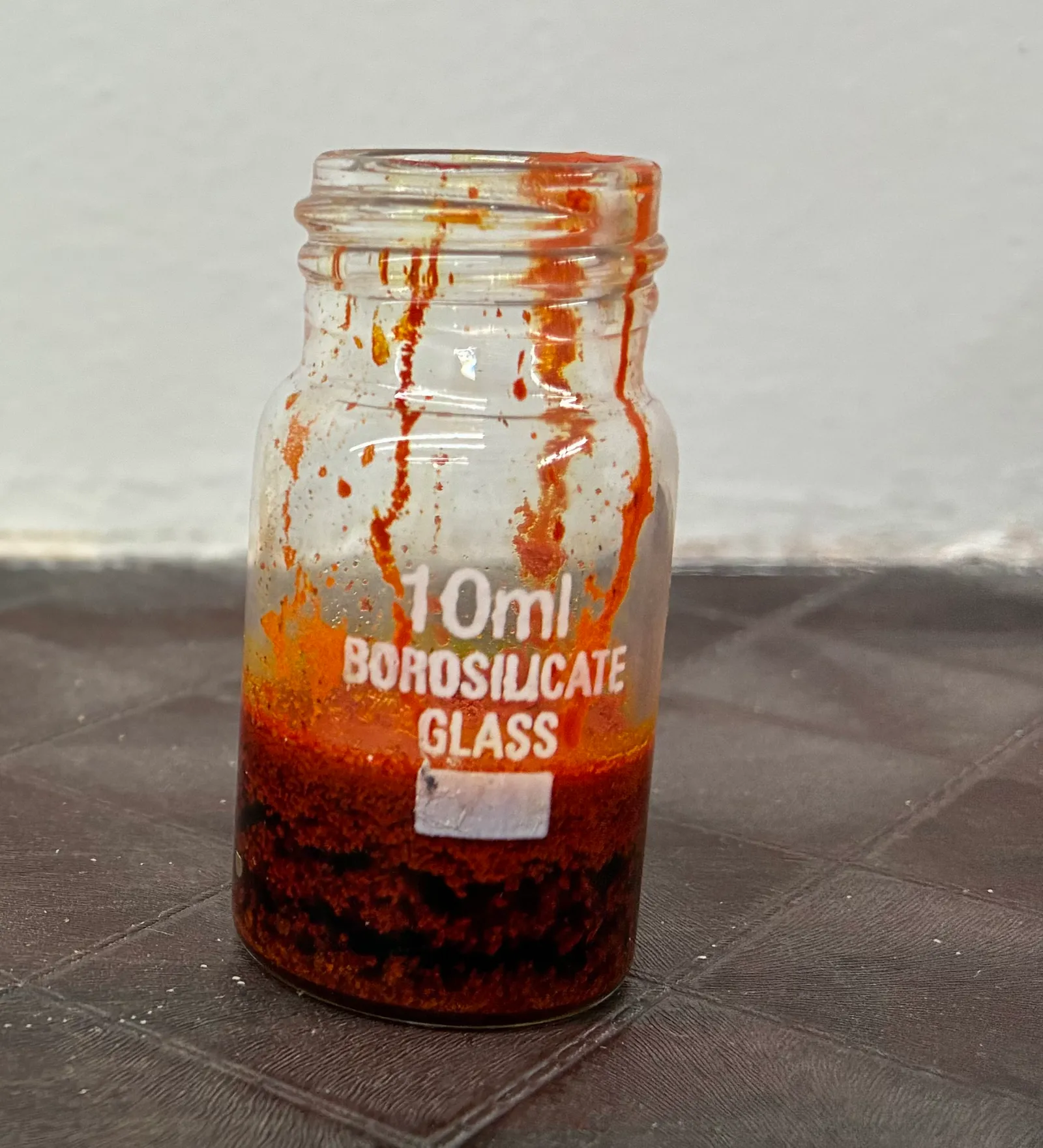
What remained was a thick, intensely coloured oleoresin: almost reddish-brown in the jar, blazing orange when spread thin. Nothing like the powder we started with, and far more concentrated than it.
An oleoresin is not a purified compound. It is the soluble fraction of the plant, minus the solvent — the curcuminoids together with the oils and everything else that came with them. Purifying one compound out of that is a separate problem, and a harder one.
An experiment nobody approved
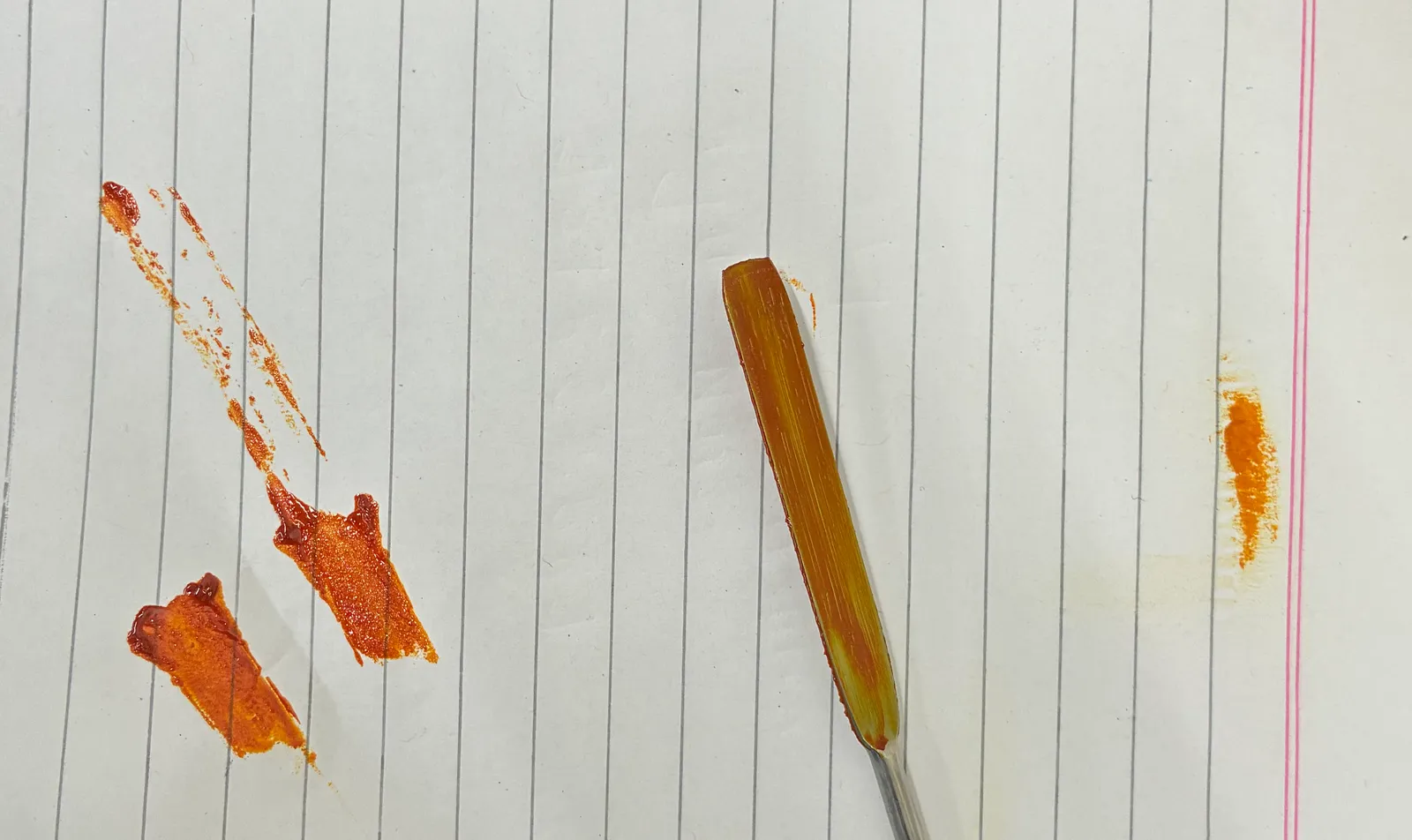
There was no protocol for this part. No control, no reference standard, no research objective. A spatula, a piece of notebook paper and some curiosity.
Somewhere between extracting turmeric and analysing it, we had accidentally made a paint. Deep amber, burnt orange, golden yellow, depending entirely on how thickly it went on. We also noticed that once dry it brushed off skin without the stain the raw powder leaves — an informal observation, not a test, and we have not repeated it.
Raupyam Art Supplies is not launching anytime soon. But we did take a photograph.
Eight months later, into the UHPLC
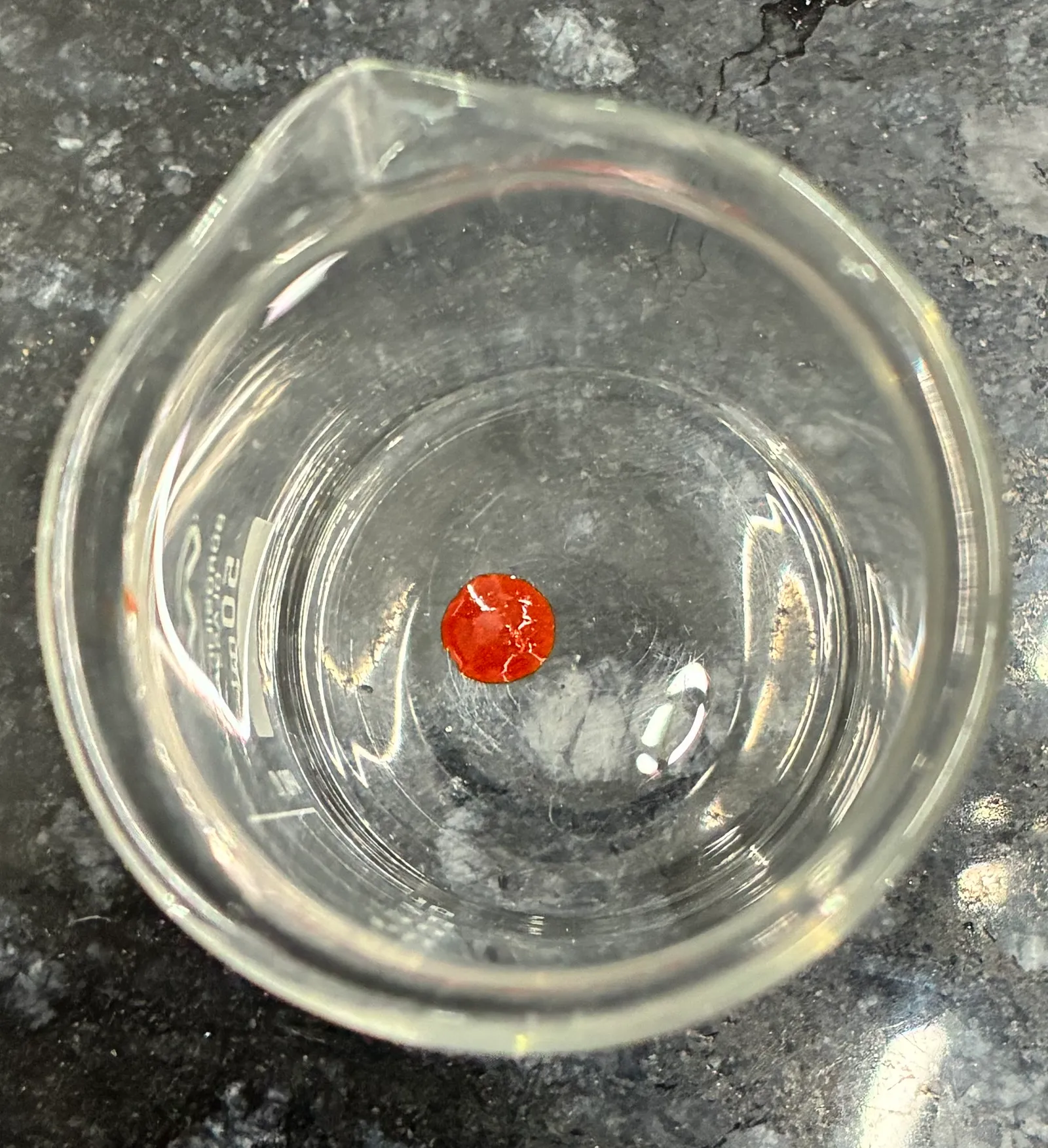
The jar went into cold storage and stayed there. Recently we took a single drop out and put it through our UHPLC.
The instrument separates a mixture by pushing it, dissolved, through a column packed with very fine particles. Compounds that interact more with the packing move slower and emerge later, so a mixture that went in together comes out one component at a time, each passing a detector that records when it arrived and what colour of light it absorbs. Three compounds go in; three peaks should come out, spaced apart, each one measurable.
We got a signal consistent with curcuminoids, in the right place, absorbing at roughly the right wavelength. What we did not get was three peaks. The congeners are coming out close enough together that our current gradient has not pulled them apart, and until it does we cannot put a number against any one of them.
We also do not yet have reference standards, which means the identification rests on retention time and the shape of the absorbance spectrum. That is consistent with curcuminoids. It is not proof, and we are not going to write it up as if it were.
The peak that was never missing
Then something we did not expect. We analysed a solution that had been standing for a couple of days, and the peak we were looking for had largely gone.
There are at least three explanations and they are genuinely hard to separate.
- Degradation. Curcumin is known to be unstable in solution, particularly at neutral and alkaline pH, and it breaks down into smaller fragments. If that happened, the material is gone.
- Precipitation. The solvent may simply not have held the material at that concentration, in which case it came out of solution and is sitting somewhere as a solid.
- Adsorption onto the glass. The curcuminoids may have stuck to the walls of the vessel, in which case nothing was destroyed and nothing fell out — it is still there, just not in the liquid we injected.
The orange streaks running down the inside of the jar, with nothing settled at the bottom, pointed us at the third. So that is what we set out to test.
We were wrong about all three.
We went back and ran the sample twelve more times: fresh against standing, four different strengths, the residue wiped off the inside of the jar, and blanks. The disappearance did not happen again. A solution left standing a full day gave the same reading as a fresh one, and a three-day-old preparation was no different.
But something odder turned up. When we made the sample ten times stronger, the measurement went up only three times. That should not happen, and we could not explain it.
So we sent the raw files to be re-analysed by someone outside the laboratory. That review found what we had missed. We had been watching one part of the chromatogram. The part we were ignoring — the material that comes straight through at the very beginning, before the separation has really begun — was behaving perfectly, rising exactly in step with concentration while ours did not.
We went back to the full spectra. The material arriving at the start absorbs light at the same wavelength, in the same shape, as the material in the peak we had been following. It is the same thing.
Add the two together and nothing is missing. Halve the amount injected and exactly half of it turns up. Our material had never gone anywhere; it was arriving at a moment we were not watching.
The cause was our own method. We dissolved the extract in methanol, and the analysis begins in something much weaker and mostly water. Put a compound that normally sticks to the column into a solvent far stronger than the one the column is running, and some of it rides through the top of the column inside its own little plug of methanol, never sticking at all. The more you inject, the more goes straight through. The peak shrinks while the material does not.
So the glass was not the answer, and neither was degradation. We had a measurement problem, and we had built it ourselves.
That is the uncomfortable part, and it is the reason this entry exists. The chromatogram looked entirely reasonable. Had we not asked why the numbers would not scale, we would have calibrated on it, published a figure, and been confidently wrong with nothing on the page to say so.
The full analytical record is published separately: twelve injections, the mass balance that closed to 49.8% when we halved the volume, the peak-purity check, and the line in our own method that caused all of it.
Open Lab 04 · The peak that was never missing →What we still cannot say
- We cannot name the peaks. Without authentic reference standards, assignment rests on retention time and spectral shape. Consistent with curcuminoids, not proof of them.
- We have not resolved the three congeners. They are eluting as one band under the gradient we ran, and a shallower gradient is the next thing to try.
- We have not yet re-run the method with the sample solvent corrected, so the recovered signal is predicted rather than demonstrated.
- We cannot say how much material was on the glass. Something was recovered from the jar wall and it carries the same absorbance, but we have no weighed mass balance for it, and whether it is adsorption, drying or deposition is unresolved.
- We have not quantified anything. No curcuminoid percentage, no extraction yield, no recovery figure — all of that needs standards we have not bought yet.
- The pigment behaviour is anecdote. It washed off skin more easily than the raw powder, once, on one pair of hands. That is a thing we noticed, not a finding.
Our next step is to prepare the sample in a solvent matched to the method and see how much of the peak comes back, and to buy all three curcuminoid standards so the peaks can be named instead of described. That will be the next one of these.
Even something you have known your whole life can hold a question nobody thought to ask.
Revisions
- 2026-11-18Section 08 rewritten. The loss of signal from a standing solution, reported here on 17 November with three candidate explanations, did not reproduce across twelve further injections. Independent re-analysis of the raw files identified the cause as our own sample solvent: the extract was dissolved in methanol and injected into a far weaker mobile phase, so part of it passed through the column unretained. Adding both bands closes the mass balance. The earlier degradation, precipitation and glass-adsorption hypotheses are withdrawn. The original wording is kept in the page history rather than removed.
- 2026-11-17Entry opened. Oleoresin extracted earlier in 2026 and held in cold storage; first UHPLC injections this month. The curcuminoid congeners have not been resolved and the fate of a standing solution is unresolved. Both stay open here rather than being left out.
This entry stays open. Results are added here as they arrive, and corrections are logged rather than quietly edited away.
Corrections and contributions
If you have run curcuminoids on a C18 column and know what we are looking at, we would like to hear from you — particularly if you have seen a mobile phase that pulls the three apart cleanly. If you have watched an active adsorb onto glassware and know how to prove it, we would like that even more. If anything here is wrong, tell us and we will correct it in place, dated, with your name on it if you want it there.
And if you simply want to know how this turns out: we will publish the answer in this entry. Write to us and we will send it to you when it is here.
care@raupyam.com · +91 74001 44899
Published work we relied on
- Poudel et al. (2019). Geographical discrimination in curcuminoids content of turmeric assessed by a rapid UPLC-DAD validated analytical method. Molecules 24, 1805. doi:10.3390/molecules24091805
- Gordon et al. (2015). Unraveling curcumin degradation. Journal of Biological Chemistry 290, 4817–4828. doi:10.1074/jbc.M114.618785
Raupyam Labs Limited. This entry describes exploratory laboratory work and makes no claims regarding any finished product, and nothing here is a health claim about turmeric or curcumin. No compound reported here has been confirmed against an authentic reference standard. Where a mechanism is offered for an observation it is labelled as a hypothesis, because that is what it is.