
Every bottle we sell claims a percentage. One-and-a-half percent salicylic acid. Two percent niacinamide. One percent bakuchiol. Between the number on the label and the truth is a measurement — and if the measurement is wrong, the label is a story we are telling, not a fact we are stating.
This is the story of the first time we tried to measure salicylic acid ourselves, and how badly it went. It is also the story of what we learned in the process — about pH, about wavelength, and about the strange fact that in analytical chemistry the loudest signal is not always the truest one. We are writing it down because other cosmetic brands might benefit from making the same mistakes we made, cheaper.
The first attempt
Our first UPLC calibration curve for salicylic acid was a mess. We had chosen an acidic mobile phase — the standard way to run a weak organic acid on a reversed-phase column — using formic acid as the acid modifier. It is a common choice, it is what many published methods use, and it is cheap to prepare. Then we ran a standard.
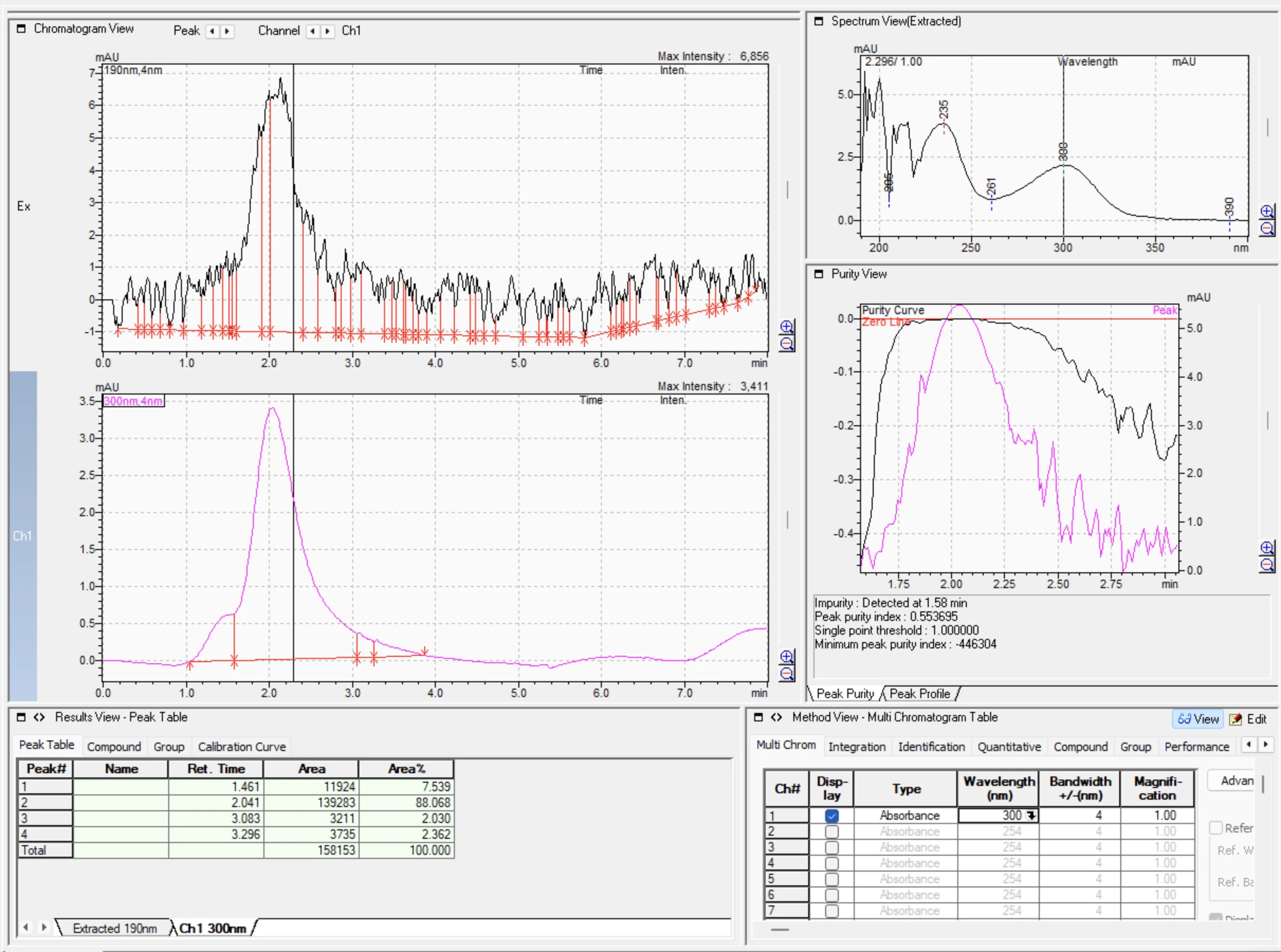
The peak drifted in retention time between injections. Its shape changed with concentration. The purity analysis failed. When we built a calibration curve, R² came in around 0.99 — respectable to an untrained eye, but below the 0.999 we require of a method we would trust. We checked our pipetting, sample prep, column, injection volume. Everything was correct. The chromatography itself was wrong.
The molecule was telling us something
The clue was in the chemistry. Salicylic acid is a weak acid with a pKa of about 2.97 — the pH at which exactly half the molecules carry an intact carboxylic acid group and half have given up their proton.
Our formic-acid mobile phase sat around pH 2.7 — right on top of that ionization boundary. Every injection was a coin-flip between two forms of the molecule. And the two forms behave differently on a C18 column, absorb UV slightly differently, and elute slightly differently. The molecule could not decide what it was, so our measurement could not either.
Principle
For a weak-acid analyte, the mobile-phase pH must sit at least two units below its pKa — far enough away that the molecule exists in one definitive form, not a wavering mix.
One change, one revelation
We switched the acid modifier. Nothing else — same column, same organic solvent, same flow rate, same injection volume, same detection wavelengths. Only the acid changed, to orthophosphoric acid at a strength that brought the mobile phase to a pH just above two. That put it almost a full unit below the pKa, so salicylic acid now exists almost entirely in its neutral protonated form. No more coin-flip.
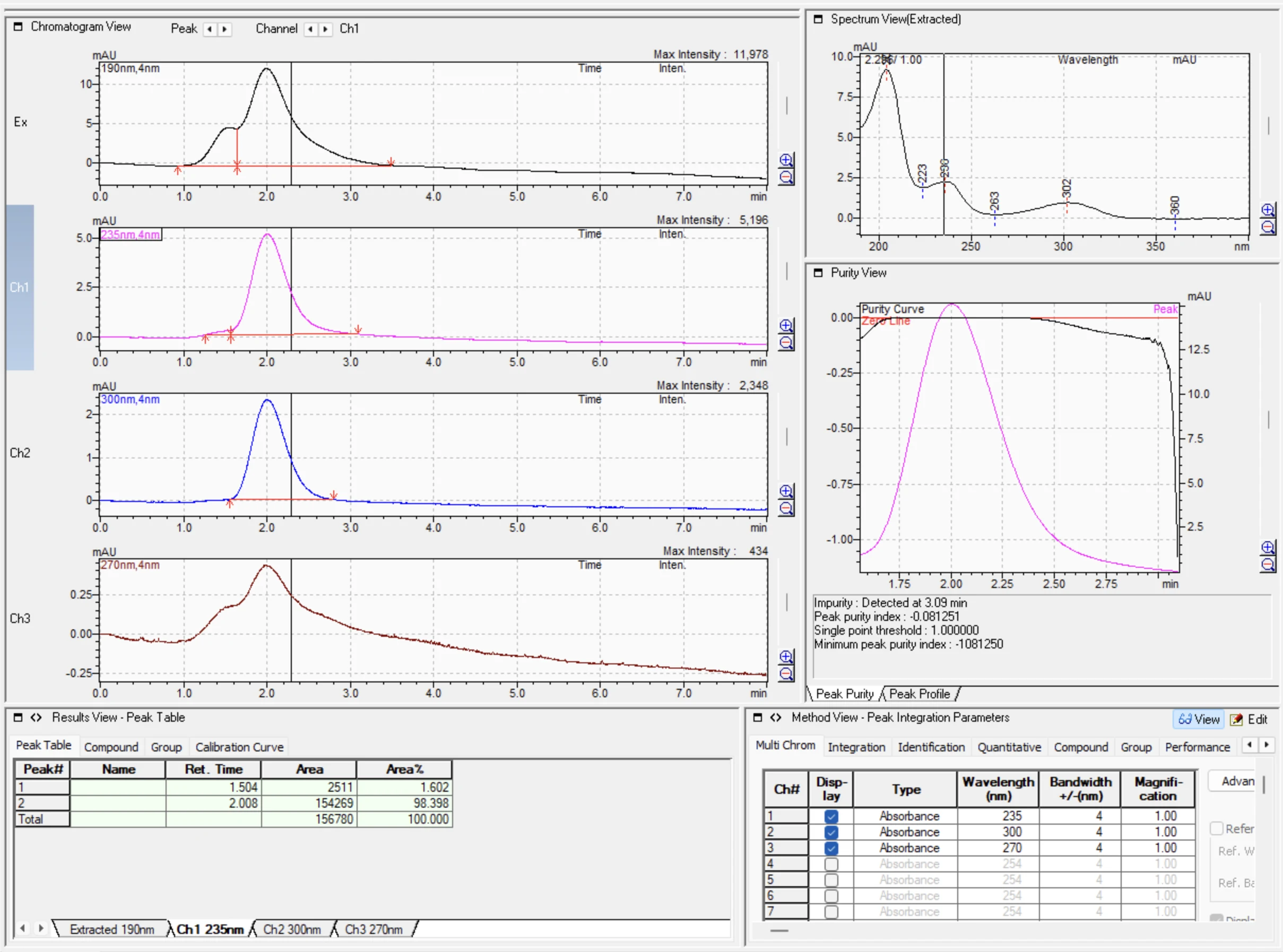
The change was not subtle. Retention time locked within one percent across every concentration. Peak shape became reproducibly Gaussian. The purity analysis stopped throwing warnings. The published two-band UV signature of salicylic acid appeared cleanly in our own data for the first time. One decision. One pH unit. Everything downstream started working.
The wavelength that wasn't
We thought we had solved it. We had solved the chemistry — but a second problem was waiting. Every UV chromophore has a favourite wavelength, where it absorbs most strongly. For salicylic acid that is around 235 nm, roughly twice the intensity of the secondary band near 300 nm. Any textbook says: measure at the strongest band, get the most signal. That is correct advice for a pure standard. It is misleading advice for a cosmetic product.
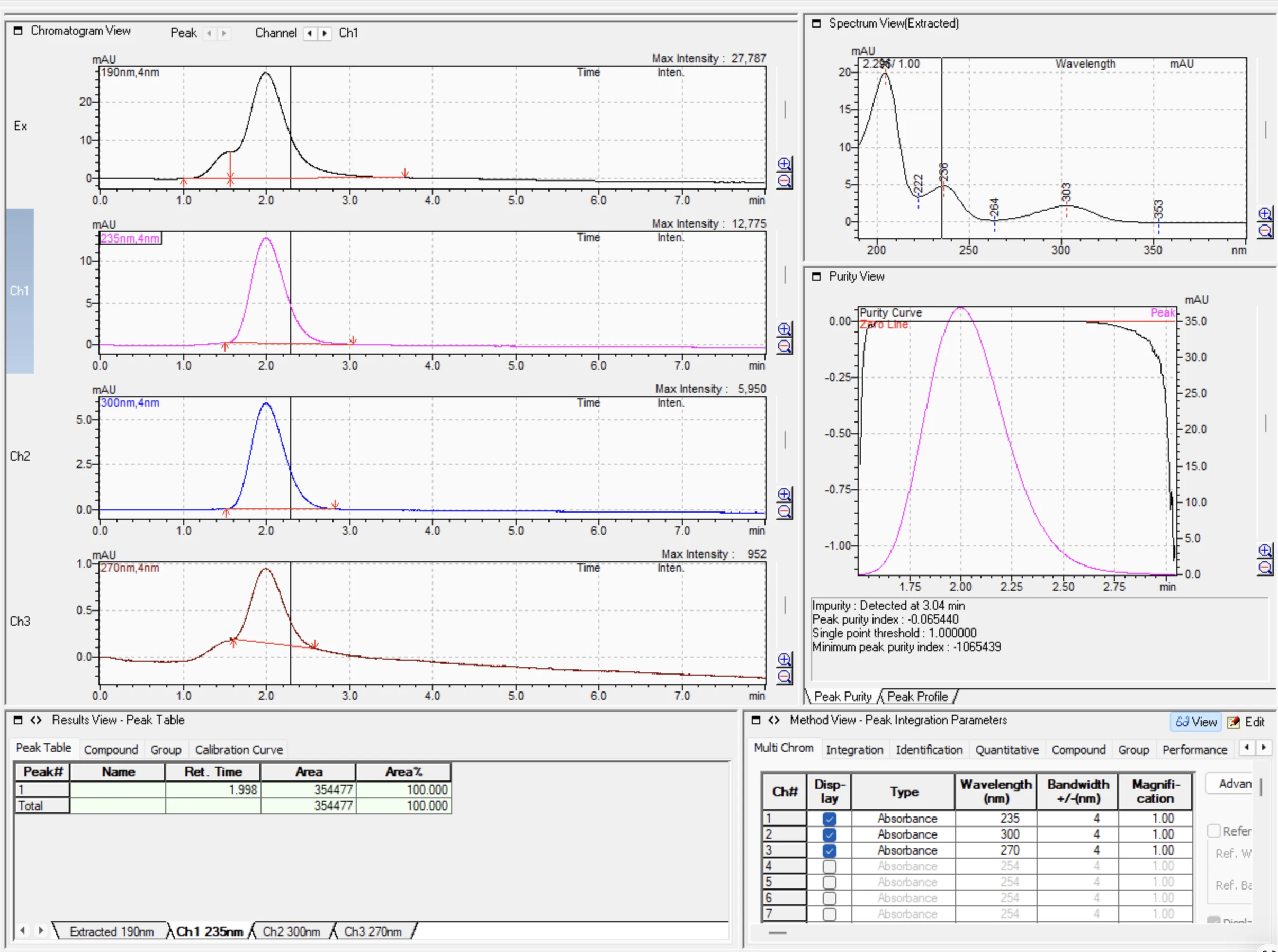
Cosmetic products are not pure standards. They carry preservatives, humectants, solubilisers, botanical extracts, sometimes UV filters — and almost all of these absorb heavily below 260 nm. Choose 235 nm for quantitation and your beautiful strong signal sits inside a chorus of interference from everything else in the jar. What matters in a matrix is not sensitivity but signal-to-noise: a smaller peak on a clean baseline gives a more trustworthy number than a big peak on a noisy one.
Principle
For pure standards, pick the wavelength of strongest absorbance. For cosmetic products, pick the wavelength where nothing else is trying to be heard.
Salicylic acid at 300 nm is quiet — but so is everything else at 300 nm. Its excipient neighbours are silent there. The signal is smaller, but there is nothing in the way. In a real cosmetic matrix, that is the honest measurement.
The decision that made it defensible
We now run every salicylic acid sample at three wavelengths simultaneously, using the photodiode-array detector to capture the whole UV spectrum:
300 nm is our quantitation channel — where the number on the label gets verified, on a baseline nothing else disturbs. 235 nm is our identity channel — the ratio between the two absorbances is a fingerprint that would shift if any impurity were co-eluting under the peak. And a third channel serves as a cross-reference to the published pharmacopoeial approach, so anyone with UPLC training can compare our numbers to a standard reference.
Three windows on the same molecule. Any one alone would be a claim. Three together, matching each other and matching published references, is proof.
A clean baseline is not a small thing
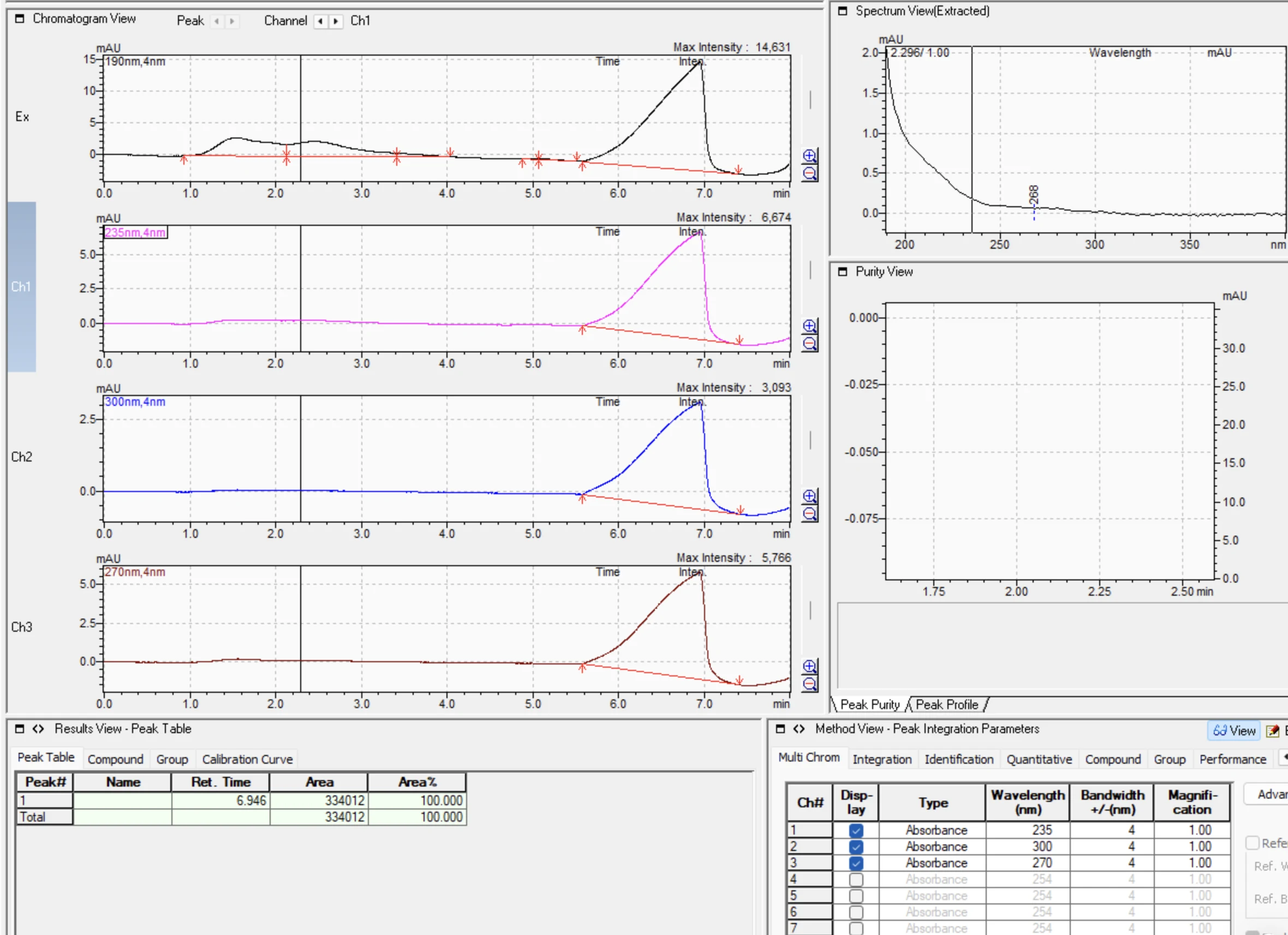
A blank is not a beautiful thing to look at. It is a chromatogram of nothing. But that nothing is the foundation of everything. When we switched from formic to orthophosphoric acid, the first thing that changed was not the peaks — it was the space between them. The baseline settled. The noise dropped. There was suddenly room for a real signal to be seen.
Most brands in Indian direct-to-consumer beauty rely on their supplier's certificate of analysis. The certificate says 99.9 percent pure; the finished product is labelled at 1.5 percent; and in between, no independent measurement happens. The chain of trust is only as strong as the weakest number nobody bothered to verify. Measuring our own materials is how we know what we are actually selling — with numbers we can defend and chromatograms we can publish.
What we did not know three months ago
We are writing this because we did not know it three months ago. We had a UPLC, a salicylic acid raw material, and a plan to run a quick calibration and start measuring finished products. Instead we spent three weeks unlearning things that seemed like they should be true: chase the strongest signal; use the mobile phase everyone uses; trust the calibration if R² looks close to one. All reasonable defaults. All, for an acidic active in a cosmetic matrix, wrong.
Every method we build now starts with two questions. What is the pKa of our active, and how far can we get the mobile-phase pH away from it? What else will be in the finished product, and which wavelength is quiet enough to see our molecule cleanly through it? Two decisions built this foundation — one pH unit and sixty-five nanometres. Chemistry, chosen carefully.
Our Raw Material Files document what we buy and what we could independently verify. These Method Notes document how we verify it. Batch reports — the actual measured concentration of each active in each production lot, cross-referenced to the number on the bottle in your hand — follow. The next note takes this method further: full linearity, and the same active measured across different suppliers.
Revisions
- 2026-09-05Note published. Method: UPLC-PDA, orthophosphoric-acid mobile phase, quantitation at 300 nm with 235 nm identity ratio.
This note stays open. Corrections are logged rather than quietly edited away.
Corrections and contributions
If you develop analytical methods for cosmetic actives and see something here we have got wrong, tell us and we will correct it in place, noted and dated. If you would like the full method conditions for your own work, write to us.
care@raupyam.com · +91 74001 44899
Raupyam Labs Limited. This note describes analytical method development and makes no claims regarding any finished product.