
Two flasks
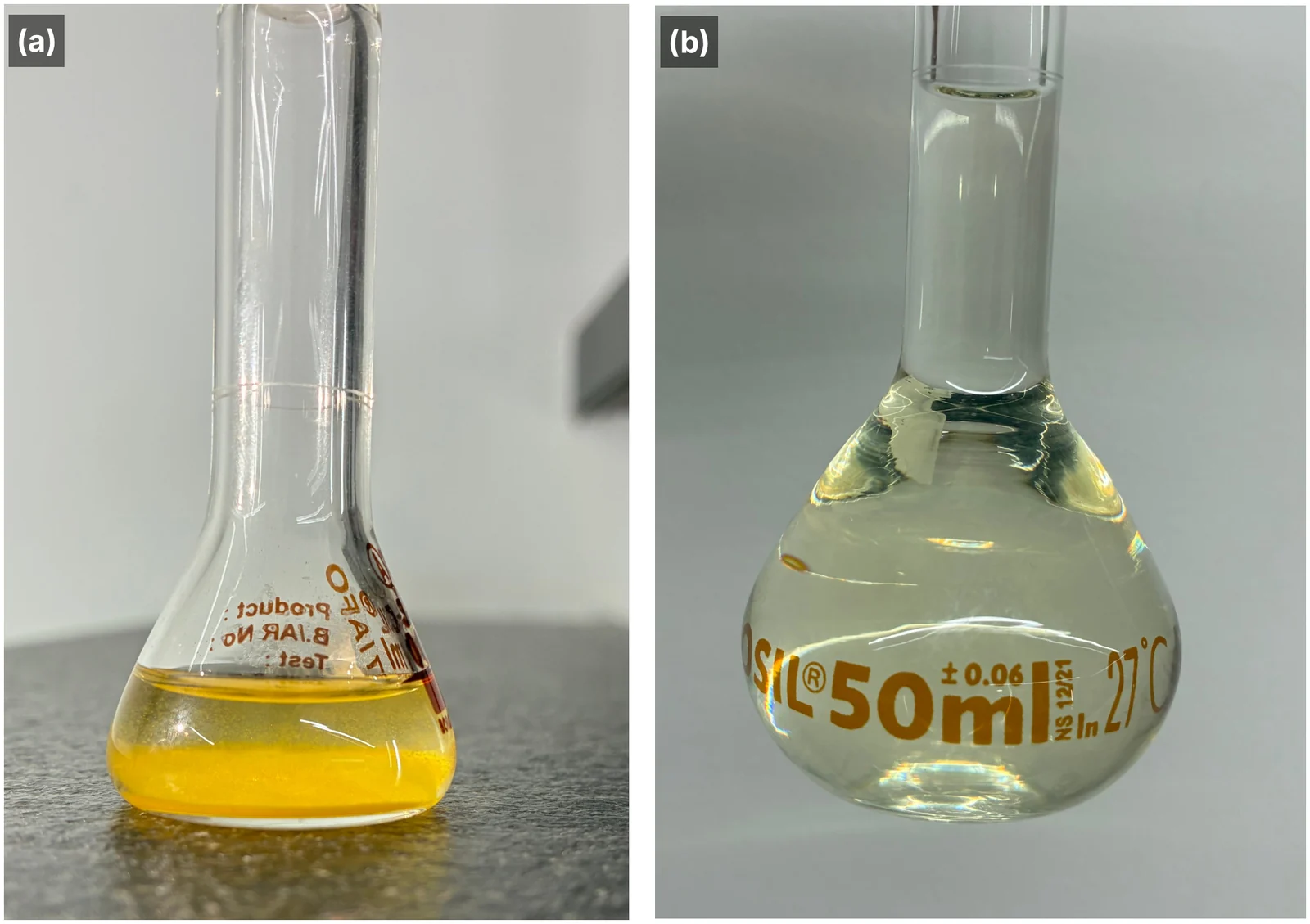
One has yellow crystals sitting at the bottom. The other is completely clear.
The obvious reading is that the first flask has a problem and the second is ready to use. The first flask did have a problem. So did the second — it measured 17.7% below what it should have — and there was nothing in it to see.
What we were measuring
Coenzyme Q10 — CoQ10 — an antioxidant used in skincare. Before a raw material goes into a formulation we want to know what we are actually working with, so we were developing a test for it on our Shimadzu Nexera, a liquid chromatography system.
The method works like this. You prepare solutions containing known amounts of the substance. The instrument measures each one and draws a peak. More material gives a bigger peak. Once that relationship is established, you can measure an unknown sample against it.
The whole procedure rests on one assumption, and it is almost never tested: that the solution contains the amount you believe it contains.
Five standards, every check passed
We prepared five concentrations and injected each one twice. The instrument behaved impeccably. Peak shapes were consistent, column efficiency was well above the usual requirement, repeat injections from the same vials agreed to within 0.23%, and nothing carried over between runs.
The amounts were the problem. Measured against a calibration we prepared separately a week later, those solutions contained roughly a tenth of what we intended. A level labelled 100 µg/mL behaved like one containing about 12.
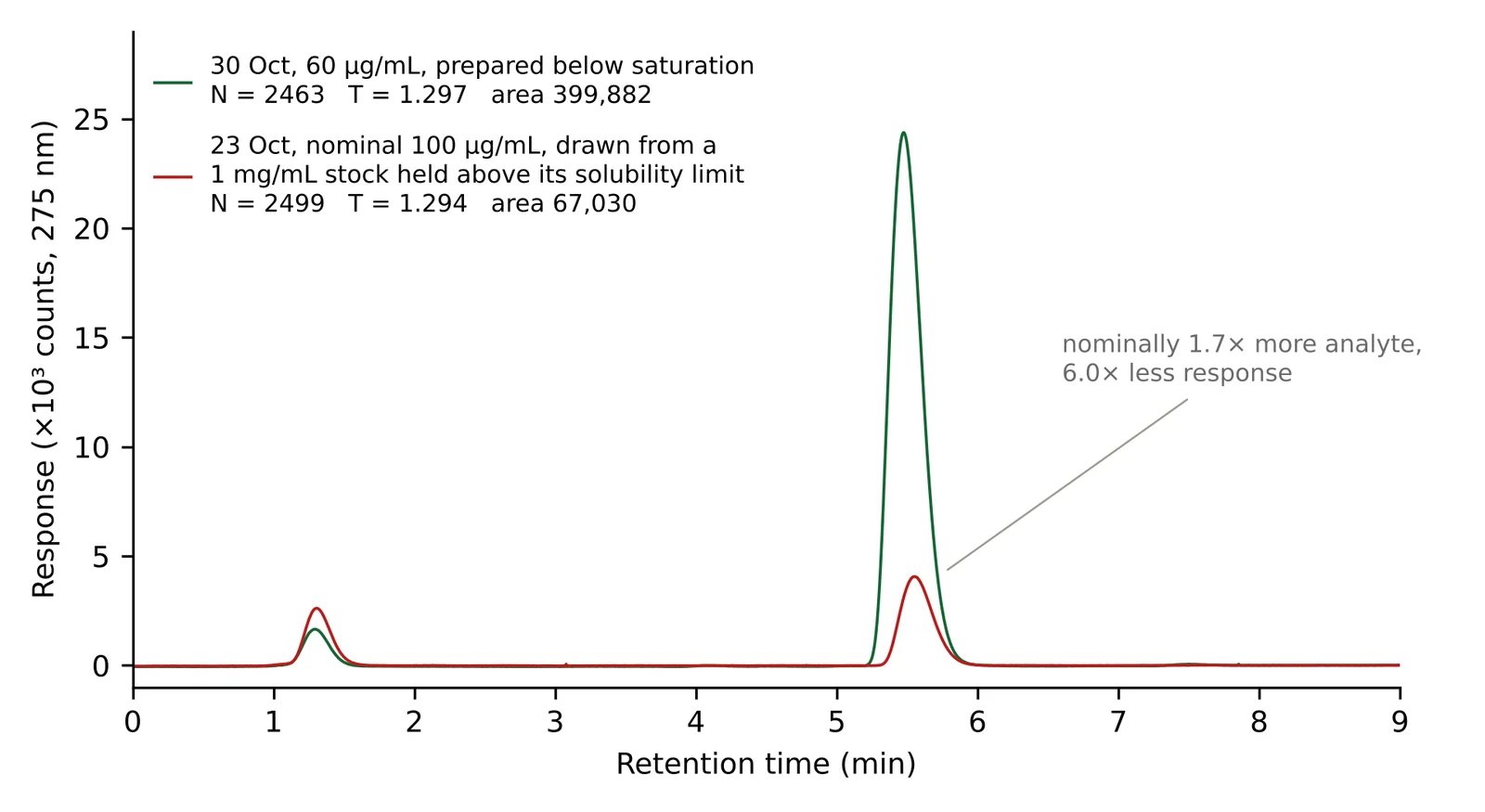
We had measured the wrong liquid very carefully indeed.
Why it happened
We had weighed CoQ10 into a mixture of methanol and ethanol, aiming for 1 milligram in every millilitre. CoQ10 barely dissolves in that mixture. Our later measurements put the limit near 206 micrograms per millilitre at room temperature — so we were asking the solvent to hold about five times what it can.
We warmed the flask to 36–37 °C and sonicated it. It went clear. We left it overnight. Later, after a spell in the refrigerator, the crystals in the photograph appeared.
It is the sugar problem. Warm water dissolves more sugar than cold, and a solution that looks clear while warm will drop crystals when it cools. CoQ10 is not sugar, but the behaviour is the same, and the consequence for an analytical standard is worse: nothing about the clear liquid tells you it is temporary.
Here is the part we did not understand at the time. The 1 mg/mL figure was not arbitrary — it is the concentration the USP monograph specifies for a coenzyme Q10 standard. But the monograph prepares that standard in neat dehydrated alcohol, and it tells you to heat it to about 50 °C for two minutes. CoQ10 melts at roughly 48 °C. So that instruction is not asking you to warm the flask. It is asking you to take the solid past its melting point, which is precisely why it works.
We took the concentration from the monograph, took its mobile phase as well, matched our diluent to that mobile phase because that is good chromatographic practice — and left behind the two conditions that made the number achievable.
Principle
An instruction and the conditions that make it work are the same instruction. Carry one across to a new solvent without the other and it quietly stops being true.
The stranger result
So we made a much weaker solution: 4.4 milligrams into 50 millilitres, about 88 micrograms per millilitre. That is comfortably below the limit we had measured. We gave it twenty hours to dissolve. It was clear. No crystals, no powder, nothing unusual at all.
Measured against the independent calibration, it read 72.5 instead of 88 micrograms per millilitre — 82.3% of what it should have been. If the entire shortfall were undissolved material, it would amount to about 0.78 milligrams somewhere on the glass. We could not see anything.
And we cannot prove that incomplete dissolution is the explanation. Transfer losses, a systematic error in our own calibration, or something we have not thought of could contribute. What we can say is that a solution which looked entirely normal read substantially low, and that nothing about its appearance gave that away.
Why the instrument said nothing
Because the instrument was doing its job. It measures what enters it.
It can tell you whether peaks are well shaped, whether repeat injections agree, whether material is carrying over between runs. Every one of those checks is about the instrument and the column. None of them is about the flask.
Think of a weighing scale that reads the same value for an object every time you put it on. That tells you the scale is repeatable. It tells you nothing about whether the label on the object is correct.
Precision and correctness are not the same thing. Our chromatography was excellent. Our solution was wrong.
What changed on our bench
These are not universal rules. They are what this particular material, in this particular solvent, taught us.
We establish the solubility limit before choosing a working concentration, rather than inferring it from the fact that a solution went clear. We avoid making concentrated stocks purely because they make the dilution arithmetic convenient — that intermediate step is where supersaturation enters, and it leaves no trace. We now treat the need for heat or sonication as a diagnostic rather than a technique. We no longer assume cold storage is the safe default, because for a material held near its limit, refrigeration is what destroys it. And every calibration sequence now includes a separately prepared check solution, injected as an unknown.
That last one is the only reason we found the second problem at all.
The instrument gave us consistent answers throughout. What we had to learn was to question the solution.
The full record — procedures, chromatographic conditions, every peak table, the regression workings and the limitations we could not resolve — is written up as a preprint. It is posted now, under DOI 10.26434/chemrxiv.15011557/v1, with the supplementary peak tables alongside it.